Norse Runes: A Study Guide to the Elder Futhark, Myth vs. History
An Alphabet That Was Also Magic
Runes were not created as a divination tool. They began, first and foremost, as a writing system used by Germanic and Scandinavian peoples from around the 2nd century CE onward, with some evidence pointing to even earlier origins. They were carved into stone, wood, metal, and bone, used for memorial inscriptions, ownership marks, jewelry, weapons, and amulets. A rune was a letter, but for the person carving it, it was also something more.
The word 'rune' carries that double meaning. In Old Norse, it relates to 'secret,' 'whisper,' 'hidden mystery.' That is not just poetic flourish. It reflects how, for these peoples, the act of writing was already loaded with intention. Each carved mark could represent a sound, but also a concept: a force of nature, a human trait, a fate. That symbolic layer is what survives today and continues to draw people to runes as a tool for self-knowledge, not only as a historical curiosity.
The Elder Futhark and Its Three-Family Structure
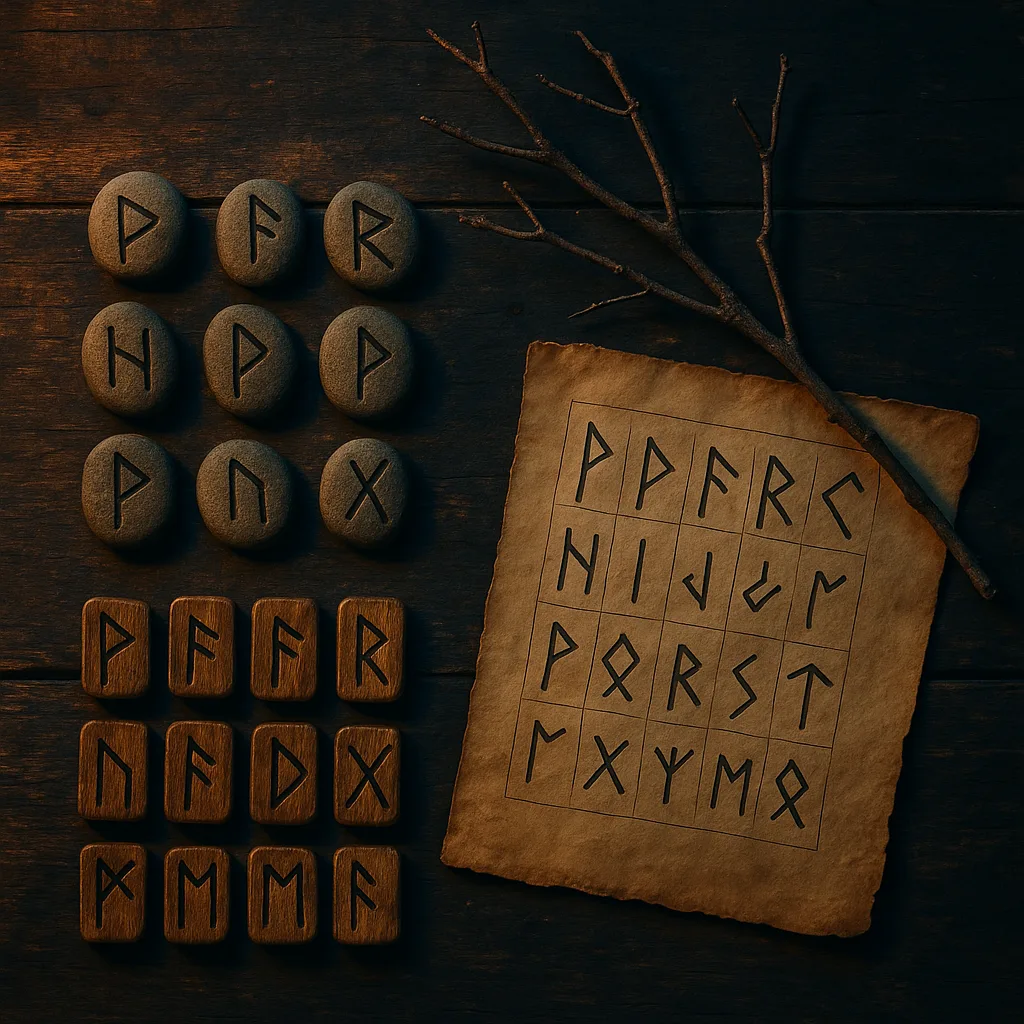
The most studied and complete runic system is the Elder Futhark, used roughly between 150 and 700 CE. Its name comes from the first six runes in the sequence: Fehu, Uruz, Thurisaz, Ansuz, Raidho, and Kenaz. There are 24 symbols in total, and understanding this structure is the real first step in studying runes, since it already organizes meaning on its own.
The 24 signs are divided into three groups of eight, called aettir (singular: aett, meaning family, clan, or lineage). Each aett has its own tone and is symbolically linked to specific deities:
- The Aett of Freyja and Freyr: runes connected to fertility, material prosperity, cycles of growth, and everyday life.
- The Aett of Heimdall: runes of tension, challenge, raw strength, and protection. They speak of obstacles and the energy needed to move through them.
- The Aett of Tyr: runes of justice, sacrifice, honor, and the larger questions of existence, such as destiny and community.
Studying the runes by aettir, instead of memorizing all 24 at once, makes things much easier for beginners. You learn eight symbols at a time, within a coherent symbolic context, then move on to the next group. Later variants emerged beyond the Elder Futhark, such as the Younger Futhark, a reduced set, and Anglo-Saxon alphabets that grew to more than thirty signs. For those just starting out, though, the 24-rune set is almost always the recommended starting point.
Odin, the Tree, and an Origin That Is Myth, Not Historical Record
There is a foundational story, recorded in the Poetic Edda, about how runic knowledge is said to have reached humankind. Odin, seeking wisdom, sacrificed himself: he hung upside down from the sacred tree Yggdrasil, without food or drink, for nine days and nine nights. In that state of extreme surrender, he is said to have glimpsed the mysteries of the runes and later passed them on to humans.
It is a powerful story, rich with symbolism about sacrifice and revelation, but it is worth holding onto an important distinction: this is mythology, preserved in medieval manuscripts, not a historical or archaeological account of the Viking Age. Mixing the two up is common, but separating myth from historical fact is exactly what makes the study of runes more solid and far less superficial.
The Point Most Rune Guides Skip: The Oracle Is Modern
This is the most important thing to know if you want to study runes with intellectual honesty: there is no archaeological evidence that the Vikings used runes as a structured divination system, the way people practice today with pouches of stone or wood pieces. The account most often cited to justify this practice comes from the Roman historian Tacitus, who described, in the 1st century CE, strips of hazel wood marked with signs, cast onto a white cloth and interpreted by a priest. The problem is that Tacitus was writing about generic Germanic tribes, long before the actual Viking Age, and his account does not specifically mention the Futhark we know today.
This does not invalidate the contemporary practice of rune divination. It is a legitimate symbolic tool for reflection, much like tarot or the I Ching. But it is a different thing entirely from claiming that 'the Vikings cast runes to predict the future exactly the way we do today.' The historically documented use of runes was as writing: memorials, ownership marks, inscriptions on weapons and jewelry, possibly carrying protective or magical intent within the act of carving itself. Interest in the oracular side of runes saw a strong revival starting in the 19th century, alongside Europe's fascination with Norse folklore, and it grew even more popular in recent decades through esoteric bookstores and online spiritual communities.
Where to Start, in Practice
If you want to study runes in a way that honors both their history and the symbolic value they hold today, a few steps can help organize the process:
- Start with the Elder Futhark. It is the most well-documented system and the reference point for nearly all serious material on the subject.
- Study by aettir, eight runes at a time, understanding the symbolic tone of each group before memorizing isolated meanings.
- Note the name, sound, and concept behind each rune. Many carry more than one layer of meaning, and forcing a single interpretation flattens the reading.
- Separate historical sources from esoteric ones. Read about archaeological findings separately from modern oracular interpretations, and learn to tell which is which.
- Handle physical runes if possible. Carving or tracing the symbols in wood, stone, or paper brings you closer to the original gesture of those who used them centuries ago.
Runes do not reward rushing. Each symbol is the result of centuries of use, reinterpretation, and, more recently, rediscovery. Getting to know that whole history, with its myths and facts clearly told apart, is what turns passing curiosity into genuine study.
Universo Astral Editorial Team · Zodiac signs and fun facts
This article was produced by the Universo Astral editorial team, with AI tools assisting research and drafting and human review before publication. If you spot anything inaccurate or outdated, let us know at our contact email.