Palmistry: What the Lines of Your Hand Reveal About Your Story
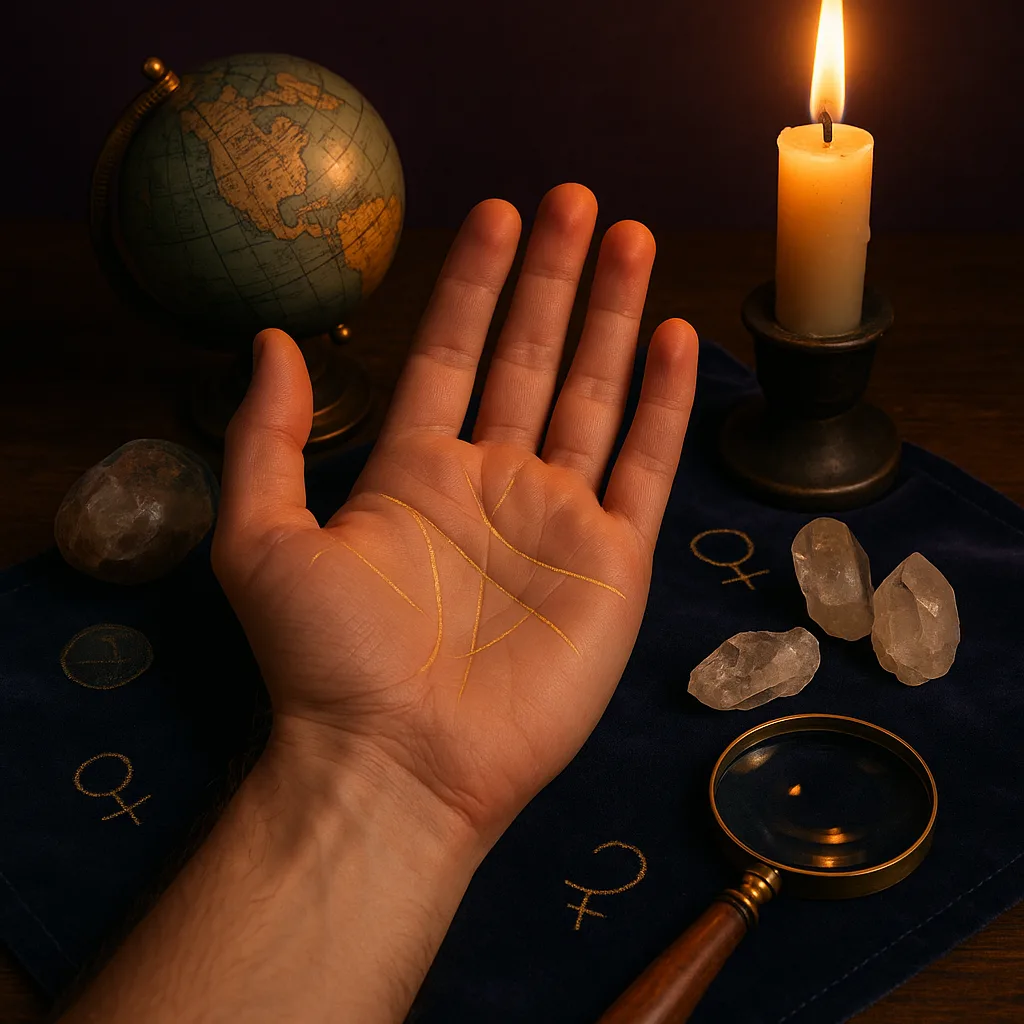
A simple gesture, ancestral knowledge
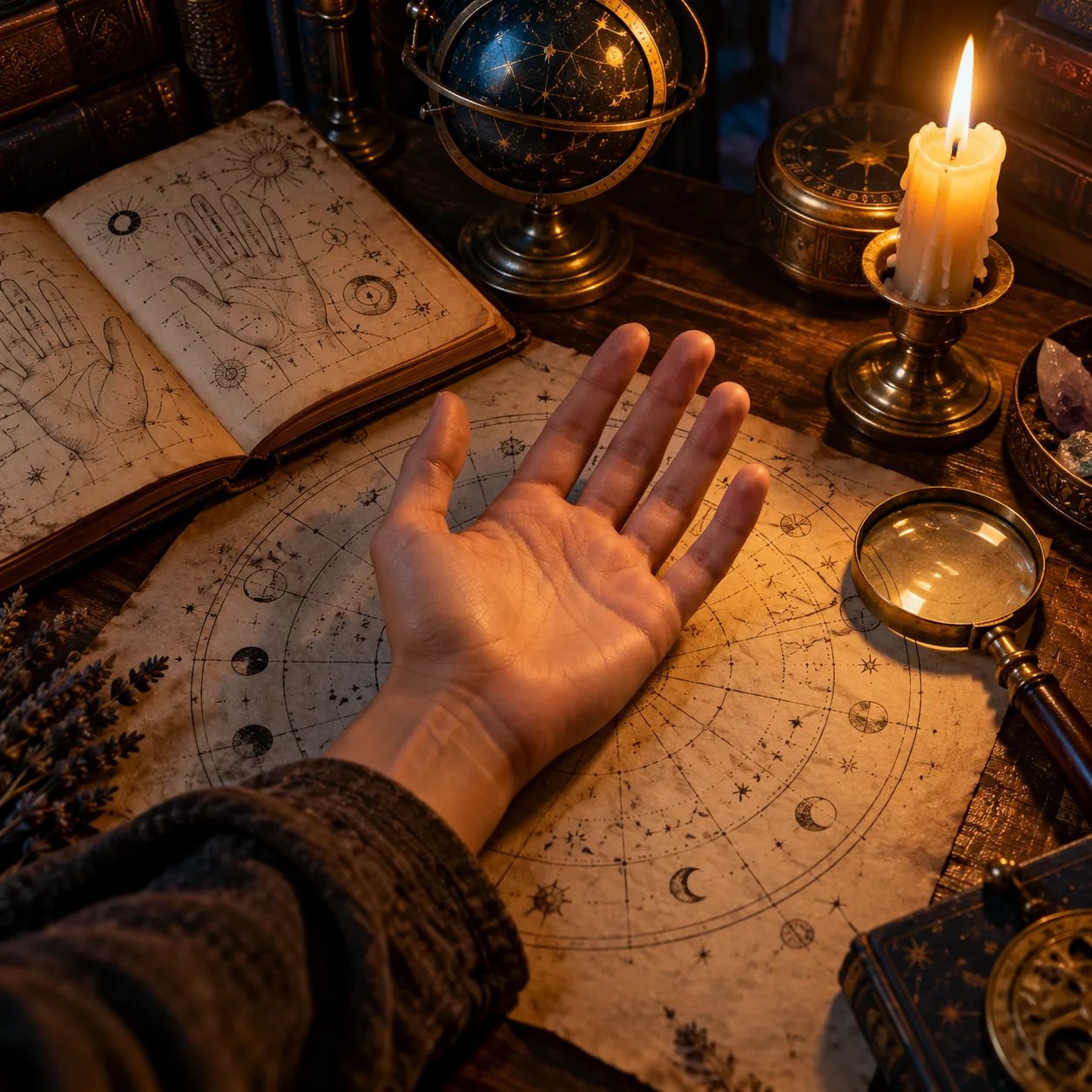
Open your hand and examine your palm in good light. You'll notice at least three deep lines crossing your skin. This is where one of the oldest divination techniques begins: palmistry, a word derived from the Greek kheir (hand) and manteia (divination). This art of interpreting the lines, elevations, and contours of the hands is believed to have originated in India thousands of years ago, rooted in Vedic astrology and the teachings of the I Ching. Legend holds that the sage Valmiki wrote one of the first texts on the subject, which later spread to China, Egypt, Tibet, Persia, and Greece.
Several historical figures took interest in the practice. Anaxagoras studied it in classical Greece; Aristotle reportedly wrote a treatise on the subject for Alexander the Great, who is said to have examined the hands of his soldiers; Julius Caesar, according to popular accounts, believed he could assess the character of his commanders simply by looking at their palms. The historical encyclopedia World History Encyclopedia documents how ancient civilizations, from Mesopotamia to Egypt, developed their own systems of divination and interpretation of bodily and celestial signs, a practice that spread and transformed over centuries as each culture adapted it to their own symbols. But one people in particular ensured the continuity and dissemination of this art over time: the Romani, for whom reading hands was, and still is in many communities, knowledge passed between generations of women.
Between superstition and attempted method
Medieval Europe's relationship with this practice was full of contrasts. In England, palm reading could be confused with witchcraft; in Germany of the same period, it took on the appearance of more structured inquiry. Later, this effort at organization took shape: at the end of the nineteenth century, researcher Edward Heron-Allen published a compendium on the art of chiromancy, and shortly after, in the early twentieth century, William G. Benham presented work attempting to establish more consistent guidelines for interpreting hands. It was mainly between the nineteenth and twentieth centuries that this practice moved from traveling camps into books and classrooms accessible to the public.
One common confusion deserves clarification: palmistry and hand analysis are not the same thing, though they're often used interchangeably. Hand analysis dedicates itself to a more objective and descriptive examination of the hand's physical traits (finger shape, skin texture, measurements), while palmistry is genuinely a divination system aimed at anticipating tendencies and future paths based on the lines of the palm. Those wanting to go beyond the lines and observe the overall shape of the palm can try the quick test that classifies hands into four elements, a complementary approach within hand analysis itself. Neither has scientific backing (collaborative knowledge platforms typically classify them as pseudoscience), which doesn't diminish their value as a symbolic tool for personal reflection, something similar to tarot or birth charts: more an invitation to introspection than a verdict about the future.
The initial trio that every reading examines
Regardless of approach, virtually every practitioner starts analysis with the three most visible lines on the palm.
The Life line begins near the base of the thumb, curves around that area, and extends toward the wrist. Traditionally associated with bodily energy and the drive to live, it's also one of the most commonly misinterpreted lines: contrary to popular belief, it doesn't determine how long someone will live. Rather, it reflects vitality and physical energy at each phase of life. A line closer to the thumb is associated with a cautious temperament and attachment to the familiar; a wider arc suggests an adventurous nature and willingness to try new things.
The Head line crosses the palm horizontally, between the life line and the heart line, and is read as an indicator of reasoning, planning, and decision-making. When it appears long and straight, it typically suggests logical and methodical thinking; when short and wavy, it implies a mind oriented toward creativity and intuition. In more detailed analyses, this line is also connected to career choices and mental profile.
The Heart line sits on the upper part of the hand and concentrates interpretations about bonds, relationships, and ways of loving. According to popular belief, when it begins under the index finger, it signals satisfaction in relationships; if it starts under the middle finger, it would indicate a tendency toward romantic instability. Shorter lines are thought characteristic of those who value emotional independence, while breaks or branches suggest multiple romantic cycles across a lifetime.
Complementary lines and their interpretive promises
Beyond these three central marks, those who study palmistry typically observe other signs on the palm, each connected to a different life aspect. The table below summarizes the location and traditional meaning assigned to each:
| Line | Location on the palm | Traditional meaning |
|---|---|---|
| Fate line (Saturn) | Vertical, through the middle of the hand to the middle finger | Career direction and sense of purpose; visibly present in roughly seven of every ten people |
| Success line (Apollo) | Near the ring finger | Creative expression, external recognition, and sense of personal fulfillment |
| Health line (Mercury) | From the base of the pinky toward the wrist | Absence is read as vital balance; marked presence suggests extra attention to health |
| Intuition line | Small arc on the side of the hand, opposite the thumb | Sensitivity beyond the five senses |
| Marriage line | Base of the pinky finger | Proximity to the heart line suggests early union; division at the end suggests separation |
- Fate line (or Saturn line): runs vertically through the middle of the hand to the middle finger and is interpreted as an indicator of career direction and sense of purpose. It's estimated that the majority of people, roughly seven of every ten, show this line visibly. Like the life line, it doesn't predict longevity but rather suggests possible directions.
- Success line (or Apollo line): linked to creative expression, external recognition, and the sense of personal fulfillment. When it appears clear and well-defined, it's read as a sign of a trajectory with good achievements and satisfaction.
- Health line (or Mercury line): runs from the base of the pinky finger toward the wrist. In this case, absence is viewed as positive: the lack of this line is read as vital balance, while its stronger presence suggests digestive fragility or the need for extra attention to health.
- Intuition line: forms a small arc on the side of the hand, opposite the thumb, near the base, and is associated with sensitivity beyond the five senses, something observed carefully by those who practice extrasensory readings.
- Marriage line: sits at the base of the pinky finger and is perhaps the most picturesque of all: popular belief says that the closer it is to the heart line, the earlier an important union would occur, and that a division at the end suggests separation. It functions far more as folkloric curiosity than as reliable indication.
When the palm reflects the starry sky
It's no accident that astrology enthusiasts also take interest in palmistry: the two traditions have walked together over the centuries, much as astrologers and astronomers historically were the same people, combining observation of the sky with symbolic interpretation. This is why the palm is also divided into areas called mounts or elevations, each named after a celestial body. The mount of Venus, at the base of the thumb, is linked to sensuality and affection; that of Jupiter, below the index finger, to ambition and a commanding spirit; that of Saturn, under the middle finger, to discipline and inner withdrawal, among other regions. A complete hand reading therefore combines analysis of the lines with the relief of these mounts, forming something like a small horoscope etched into the skin itself.
If you decide to examine your palm more closely after reading this, remember that no line remains fixed as a definitive mark. Skin transforms, scars appear, and the contours of the hands change over the years. This is why many traditional practitioners say the hand tells a story always in reconstruction, not a destiny sealed from birth.
Frequently asked questions
Does palmistry have scientific backing?
No. Both palmistry and hand analysis are classified as pseudoscience by collaborative knowledge platforms, without support from scientific studies. Their value is symbolic and introspective, similar to tarot or birth charts, not a prediction tool based on empirical evidence.
What's the difference between palmistry and hand analysis?
Hand analysis descriptively examines the physical traits of the hand, such as finger shape, skin texture, and measurements. Palmistry goes further and interprets the lines of the palm as indicators of future tendencies, making it a divination system.
Does the life line indicate how long someone will live?
No. This is one of the most misunderstood interpretations on the subject. Traditionally, this line reflects energy and physical vitality at each phase of life, not the length of a person's existence.
Who brought palmistry to Europe?
Romani communities played a central role in spreading and preserving this practice over the centuries, transmitting the knowledge between generations of women. In medieval Europe, palm reading received different receptions: in England it was associated with witchcraft, while in Germany it took on more structured investigative characteristics.
Can the lines on your hand change over time?
Yes. Skin transforms, scars appear, and the contours of the hands shift with years. This is why traditional practitioners understand palm reading as a story in constant reconstruction, not as a fixed destiny set from birth.
Recomendado
Astro Reflexo
Descubra o que os astros revelam sobre quem você é. Em menos de um minuto, calculamos seu Sol, Lua e Ascendente com precisão astronômica e uma inteligência artificial escreve um resumo personalizado só para você.
Universo Astral Editorial Team · Zodiac signs and fun facts
This article was produced by the Universo Astral editorial team, with AI tools assisting research and drafting and human review before publication. If you spot anything inaccurate or outdated, let us know at our contact email.