I Ching vs Tarot: How Two Oracles Ask Different Questions and Give Different Answers
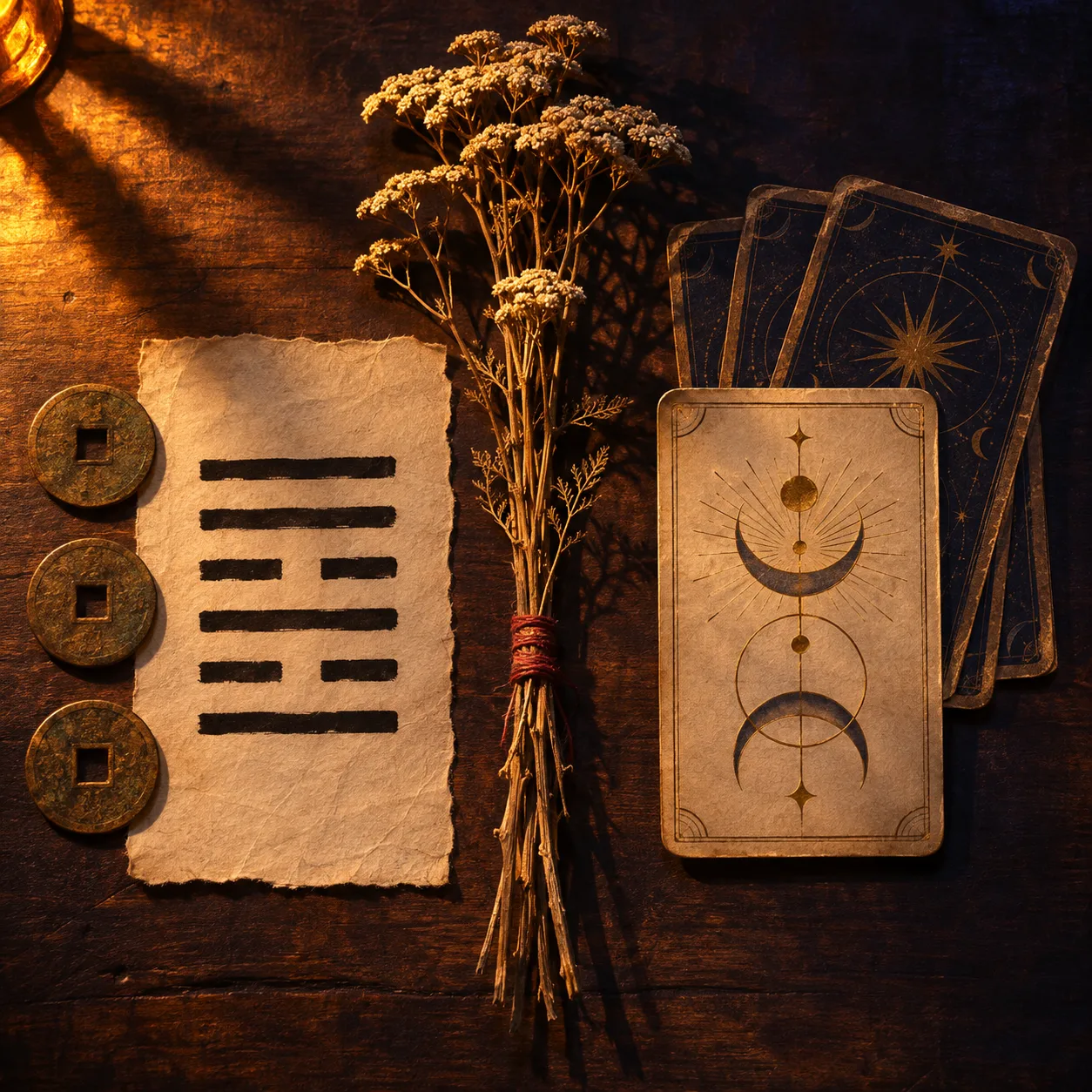
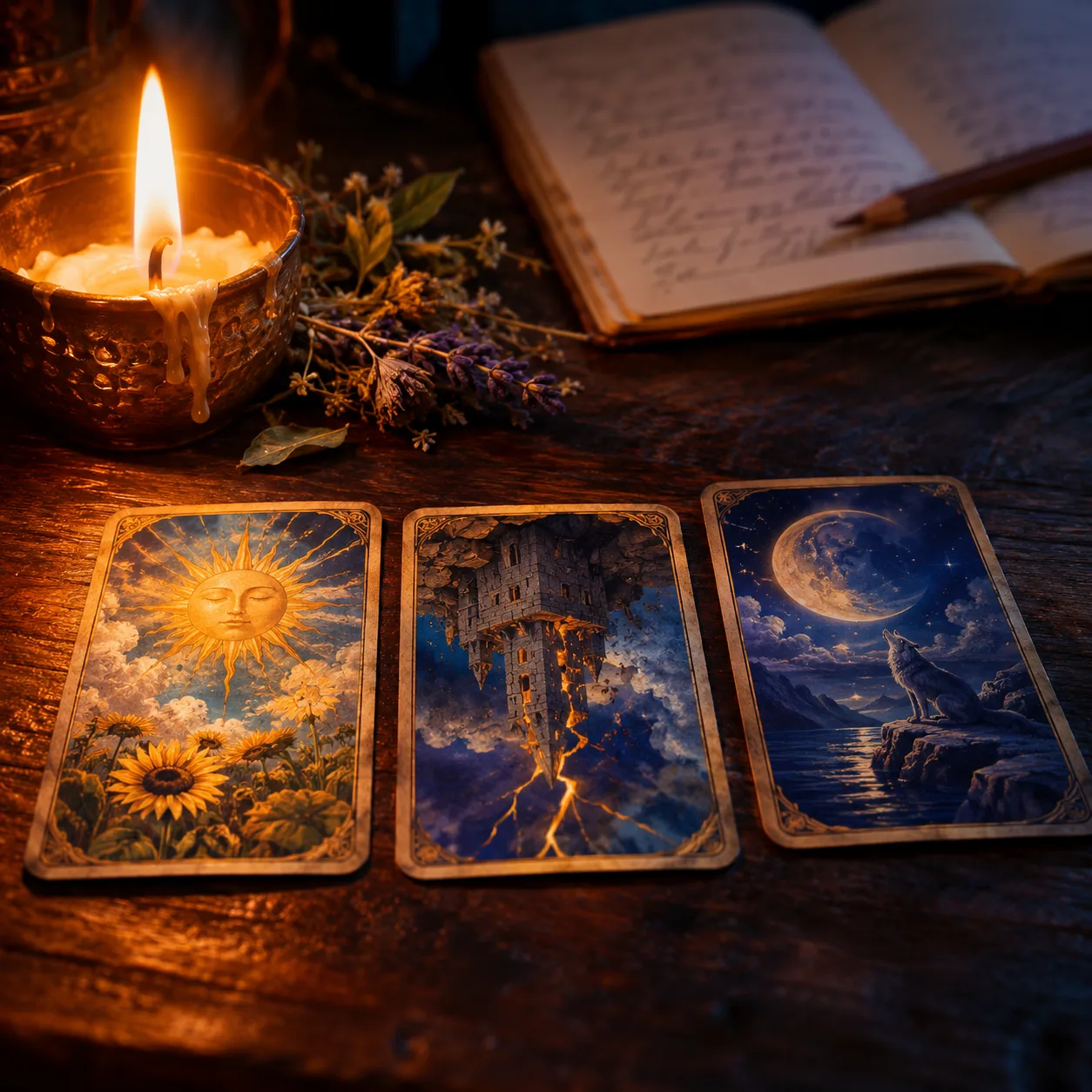
Tossing three coins six times and consulting a Chinese text more than two thousand five hundred years old is a very different experience from shuffling seventy-eight illustrated cards and drawing three of them onto a table. It's not just a matter of aesthetics or geographic origin. The I Ching and tarot were built on distinct internal logics, and that structural difference explains why one serves certain questions better while the other suits different ones.
A closed system of 64 positions versus a deck of 78 narrative cards
The Yijing, or I Ching, is one of the Five Classics of Chinese Confucianism. Its oldest layer, the eight trigrams and sixty-four hexagrams, is attributed to the mythical figure Fu Xi, but tradition holds that around 1050 BCE the so-called King Wen organized the six-line combinations, numbered them all, and gave each one a name. By around 800 BCE an established written text, known as the Zhou Yi, already existed, as the Encyclopaedia Britannica describes.
The mathematical logic behind it is simple to state and powerful in practice: each hexagram is built by stacking two three-line trigrams, for a total of six lines. Since each line can be either yin (broken) or yang (solid), the system has exactly 2 to the power of 6, or 64 possible combinations. There is no hexagram 65. It's a closed, finite system, and each of the 64 positions represents an archetypal situation of change, with a short 'Judgment,' a poetic image, and commentary on each of the six lines.
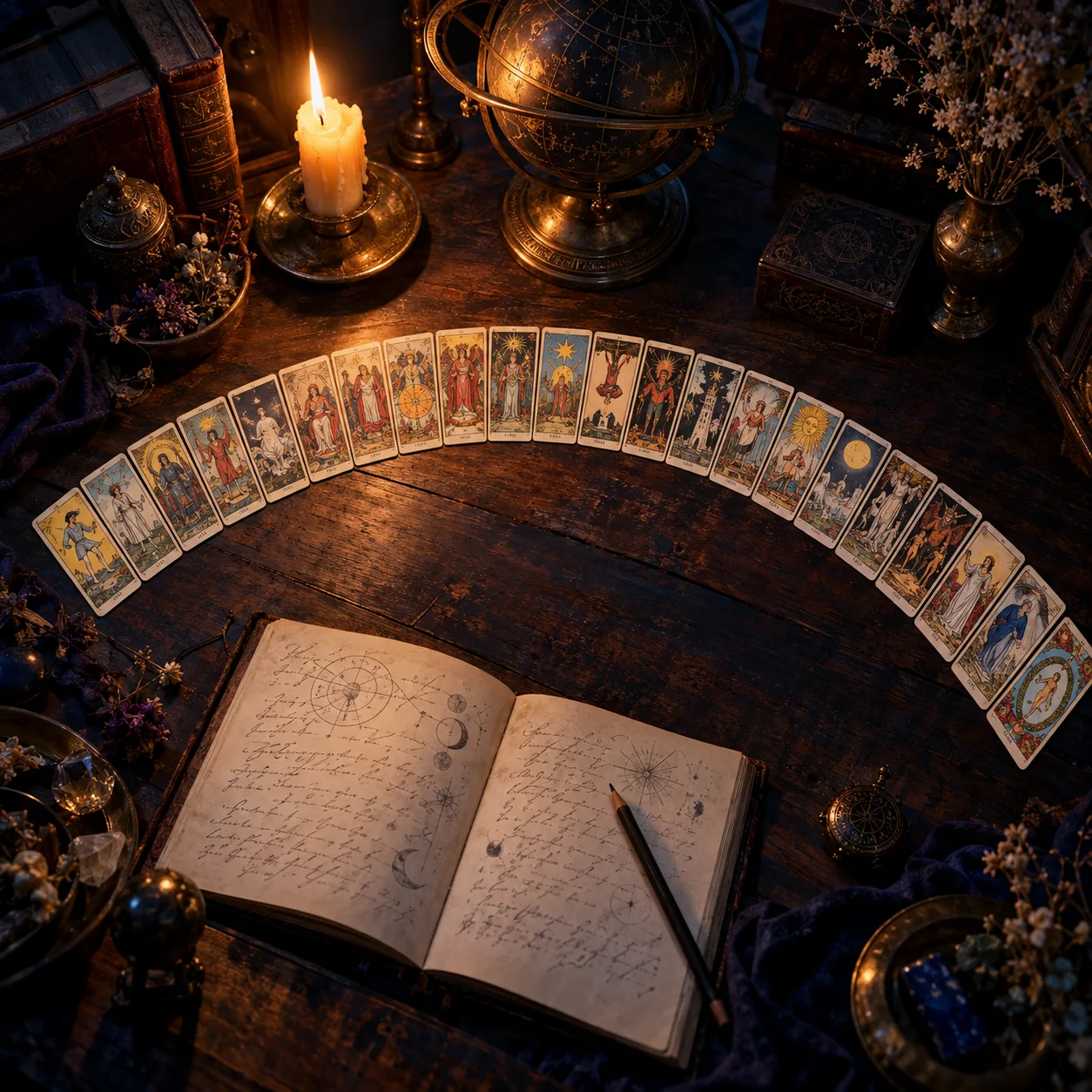
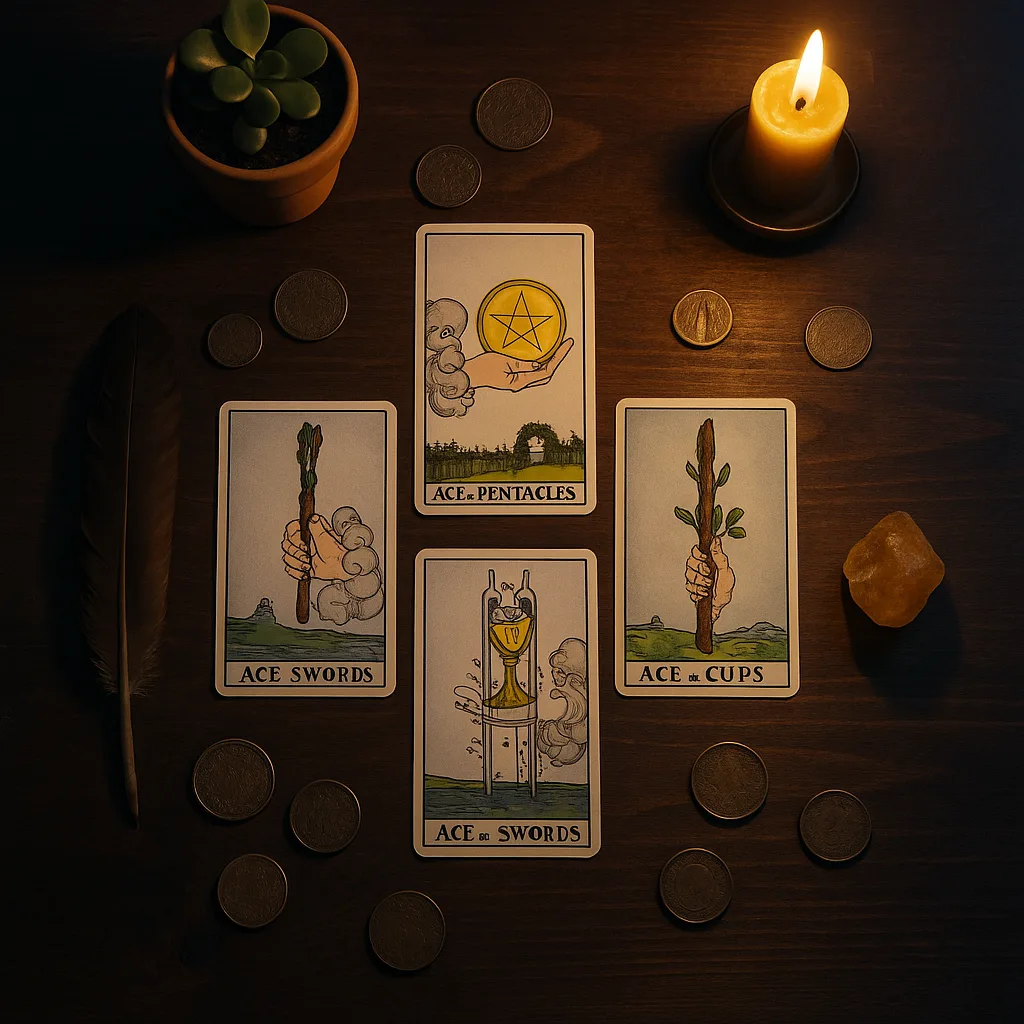
Tarot follows a completely different logic from birth. According to the Metropolitan Museum of Art's account of tarot's history, tarot cards were created in Italy in the 1430s, in the region spanning Venice, Milan, Florence, and Urbino, and originally served a card game enjoyed by Renaissance nobility, with no divinatory function whatsoever. The modern standard deck has 78 cards: 22 major arcana (from the Fool to the World) and 56 minor arcana divided into four suits of 14 cards each, following a structure of king, queen, knight, and page inherited from traditional Italian suits. Unlike the I Ching, tarot is not a closed combinatorial system generating 'logical positions.' Every card is already a complete scene, with characters, setting, and action, especially after the 1909 redesign.
From parlor game to oracle: the historical turn few people know about
One of the most revealing points for understanding the difference between the two systems is the timeline of their use. The I Ching was born as a divination tool, used by court sorcerers of the Zhou dynasty from its very origin. Tarot, by contrast, spent roughly 350 years as nothing more than a card game, with no symbolic or oracular pretensions at all.
The turning point came in 1781, when French scholar Antoine Court de Gébelin published, in his work Le Monde Primitif, the theory that tarot was actually an ancient Egyptian book of secret wisdom, an idea now recognized as academic misinformation with no real historical basis. That essay, which also included a text by the Count of Mellet dubbing the cards the 'Book of Thoth,' laid the groundwork for esoteric tarot. Shortly after, in 1791, occultist Jean-Baptiste Alliette, known as Etteilla, released the first deck designed specifically for divination rather than play.
The milestone that cemented tarot as a tool for self-knowledge was the Rider-Waite-Smith deck of 1909, created by artist Pamela Colman Smith in collaboration with occultist Arthur Edward Waite. Smith's great innovation was illustrating even the minor arcana with full narrative scenes, cards that had previously been just suit numbers, as in an ordinary deck. That decision is what makes tarot so closely tied to intuitive reading today: practically every card tells a small visual story.
The I Ching also went through layers of interpretation over the centuries, but of a philosophical nature, not a reinvention of its function. The so-called Ten Wings, commentaries traditionally attributed to Confucius, expanded the ethical and philosophical reading of the hexagrams, but without altering their original oracular function or their numerical structure.
How each one is consulted: two procedures, two kinds of chance
The way each system generates an answer is also radically different, and here lies one of the least discussed details about the I Ching: there are two traditional consultation methods, and they don't carry the same odds.
The oldest method uses fifty yarrow stalks. One is set aside at the start and left out. The other 49 go through a sequence of divisions and countings in groups of four, repeated three times to form each line, and six times in total to form the complete hexagram. Each line receives a numerical value, 6, 7, 8, or 9, which determines whether it is yin or yang and whether it is 'changing,' meaning about to turn into its opposite.
The three-coin method emerged more than a thousand years later and is much faster: simply toss three coins six times, once for each line, from bottom to top. The difference between the two methods isn't just speed, it's statistical. In the coin method, the odds of getting 6, 7, 8, and 9 are 2 in 6, 6 in 6, 2 in 6, and 6 in 6, a relatively balanced distribution across few possible outcomes (2³, or 8 combinations per coin toss). In the yarrow-stalk method, the odds are 1, 7, 3, and 5 (out of 16), and the number of possible permutations across the full process exceeds 16 million. This means the older method produces 'changing' lines at different frequencies than the more popular modern method, a detail of texture in the chance mechanism that the Chinese system itself acknowledges internally.
When a line is 'changing,' it transforms into its opposite and generates a second hexagram, showing the situation in flux, something like 'where it comes from, where it's heading.' Tarot has no equivalent to this. Shuffling and drawing cards doesn't assign different odds to specific positions in a spread; chance there is uniform, spread equally across the 78 cards, and the complexity of a reading comes from the symbolic interpretation of the cards in relation to one another, not from any internal mathematics of the method.
Side-by-side comparison: the two systems
| Criteria | I Ching | Tarot |
|---|---|---|
| Geographic origin and era | China, Zhou dynasty, text stabilized around 800 BCE | Northern Italy, 1440s |
| System units | 64 fixed hexagrams (2 trigrams of 3 lines, 2⁶ combinations) | 78 fixed cards: 22 major arcana and 56 minor arcana in 4 suits |
| Original function | Divination manual used by court sorcerers from the start | Aristocratic parlor card game for about 350 years |
| Chance mechanism | Yarrow stalks or three coins, generating a number from 6 to 9 per line | Shuffling and drawing cards from a deck |
| Esoteric turning point | Divinatory function built in from the origin | Antoine Court de Gébelin, 1781, Egyptian-origin theory |
| Key reference text | Zhou Yi and the Ten Wings, commentaries attributed to Confucius | The Pictorial Key to the Tarot, by A. E. Waite, 1910 |
| Answer format | Short statement ('Judgment') and possible second situation via changing lines | Visual, narrative scene, usually arranged in spread positions |
Which question each oracle answers best
The structure of each system shapes the kind of question it tends to answer most clearly. The I Ching, being a closed system of 64 situations tied to a Chinese tradition of strategic and ethical decision-making, has historically handled questions about how to act within an unfolding situation particularly well: should I act now or wait, what is the real trend of this moment, what changes if I take this path. The presence of changing lines reinforces this process-oriented character, since the oracle shows not only the current state but also where the situation tends to evolve.
Tarot, having been born from a game with court cards and figurative trumps, and having been reinterpreted in the 20th century under the influence of Carl Jung's ideas about archetypes, tends to work better for open-ended questions about emotional patterns, relationship dynamics, and self-knowledge. Spreads with multiple positions (past, present, future, for example) give tarot a kind of 'spatial map' that the I Ching traditionally doesn't use, since it generates one or, at most, two situations per consultation, not a panel of simultaneous positions. Anyone who has tried a three-card reading knows how much this positional format changes the interpretation; there are even common mistakes that can trip up this kind of spread, described in the article on common mistakes in three-card tarot readings.
Neither system should be reduced to 'just another oracle.' The I Ching carries the weight of being a classic Confucian philosophical text, part of the traditional Chinese educational canon. Tarot, before becoming an esoteric tool, was and remains recognized as a work of Renaissance art, with historic decks like the Visconti-Sforza (commissioned by noble Milanese families between 1450 and 1480) catalogued in museums such as the Met itself.
How to choose between the two (or use both)
There's no hierarchy of accuracy between the systems, only fitness for purpose. A practical approach is to look at the nature of your question before picking the tool:
- If the question concerns a concrete decision and you want to understand the trend of a situation in motion, the I Ching tends to deliver a more direct, process-oriented answer, since its Judgment format and changing lines were designed exactly for that.
- If the question involves emotional patterns, self-knowledge, or a multi-layered relationship dynamic, a tarot spread with specific positions tends to open up more interpretive room, because each card already brings a ready-made narrative scene for association.
- If you want to compare what has changed between one question and another over time, the I Ching offers this natively through the second hexagram generated by changing lines, something tarot only replicates if the querent decides to do a new spread.
- Nothing stops you from consulting both systems about the same topic at different times, as long as you understand they are distinct symbolic languages, not two competing methods trying to land on the same 'objective result.'
Anyone already studying the major arcana can find a complete guide to each card's meaning and where to start in the article on the 22 major arcana of tarot.
Frequently asked questions
I Ching or tarot: which is better for beginners?
Neither is objectively easier or better suited to beginners, but tarot tends to have a more visual entry point, since RWS cards show illustrated scenes that make intuitive association easier. The I Ching requires more familiarity with Chinese concepts like yin, yang, and trigrams before it fully makes sense.
What's the difference between I Ching and tarot in how they generate an answer?
The I Ching generates its answer through a mathematical chance procedure (coin tosses or yarrow-stalk manipulation) that produces a hexagram among 64 fixed possibilities. Tarot generates its answer by shuffling and drawing cards from a 78-card deck, without assigning different odds to each position in a spread.
Can you use I Ching and tarot in the same reading?
You can use both systems at different times on the same topic, understanding that each responds to a particular kind of question with its own logic. The I Ching tends to show the trend of a situation in motion, while tarot tends to open up broader narrative and emotional layers.
Was tarot always used for divination?
No. According to the Metropolitan Museum of Art, tarot emerged in Italy in the 1430s as a parlor card game. Only starting in 1781, with the publication of Antoine Court de Gébelin, did the deck become associated with supposed Egyptian esoteric wisdom, giving rise to the divinatory use that took hold in the following centuries.
Why does the I Ching sometimes show two hexagrams instead of one?
This happens when one or more lines in the consultation are classified as 'changing,' meaning they are about to flip into their opposite (from yin to yang or vice versa). When this occurs, a second hexagram forms representing the situation in transformation, complementing the reading of the first.

Recomendado
Lewtemi Espelho de tarô acrílico tarô
Lewtemi Espelho de tarô acrílico tarô cartão decoração de parede mística presentes de bruxa para mulheres espaço sagrado cartomante espiritualidade astrologia bruxa magos arte decoração
Vanessa Teixeira · Tarot and moon transits · Universo Astral Editorial Team
This article was produced by the Universo Astral editorial team, with AI tools for research and drafting, and went through automated checks of structure, links and sources before going live. If you spot anything inaccurate or outdated, let us know at our contact email.