How to Do Your First Rune Reading: Methods, Layouts and Practical Tips
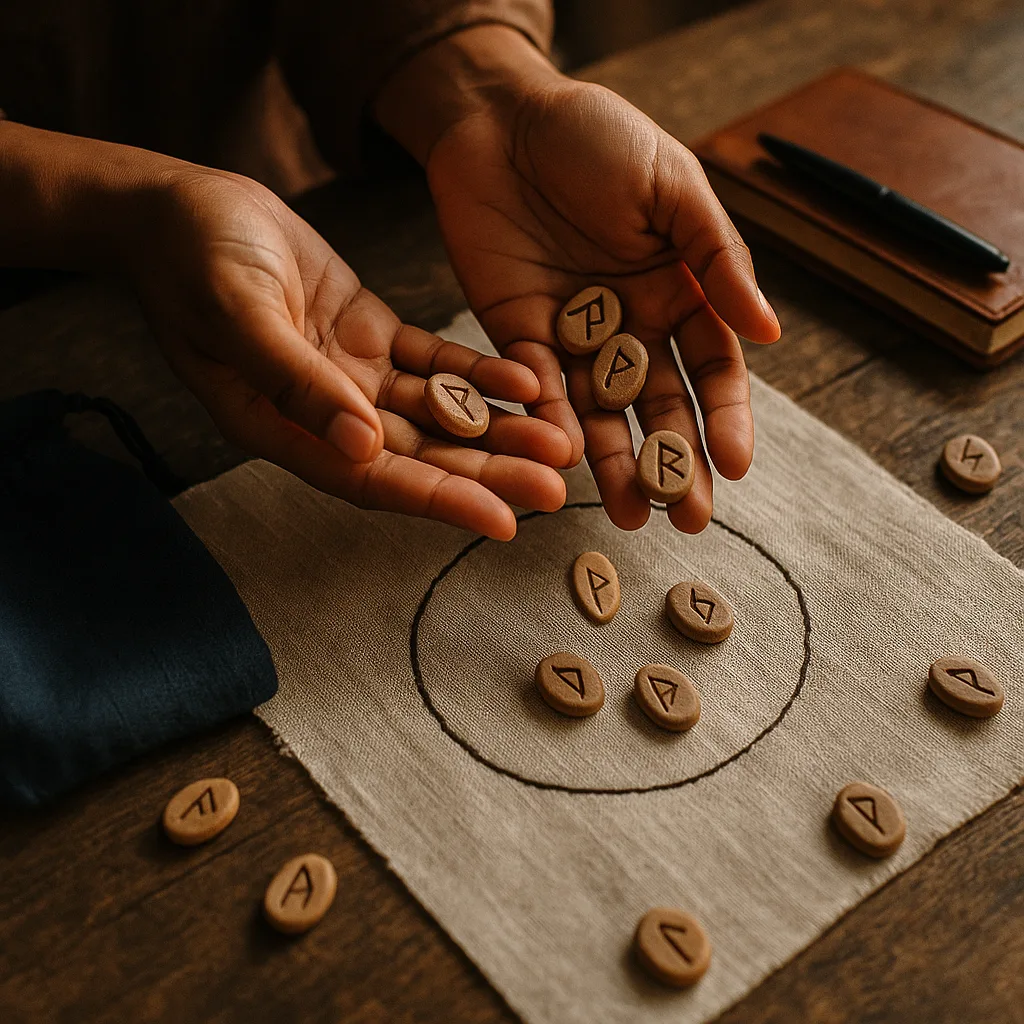
Moving from Theory to Actually Casting the Runes
Plenty of people learn the names of the 24 runes, memorize a handful of meanings, and then get stuck the moment they sit down to do an actual reading. How do you cast them? How many runes should you use? What happens if one lands reversed? This guide is for anyone who has moved past the historical curiosity and is ready to work with their rune set, whether for self-reflection or as a daily tool for insight.
Studying the origins of the alphabet or the mythology behind it is one thing. What matters here is the experience of the reading itself: the act of casting, the pause before turning the pieces over, and the interpretation of whatever shows up on the table.
Choosing (or Making) Your Own Rune Set
Before any reading, there's a decision to make: which rune set to use. Practitioners generally take one of three paths.
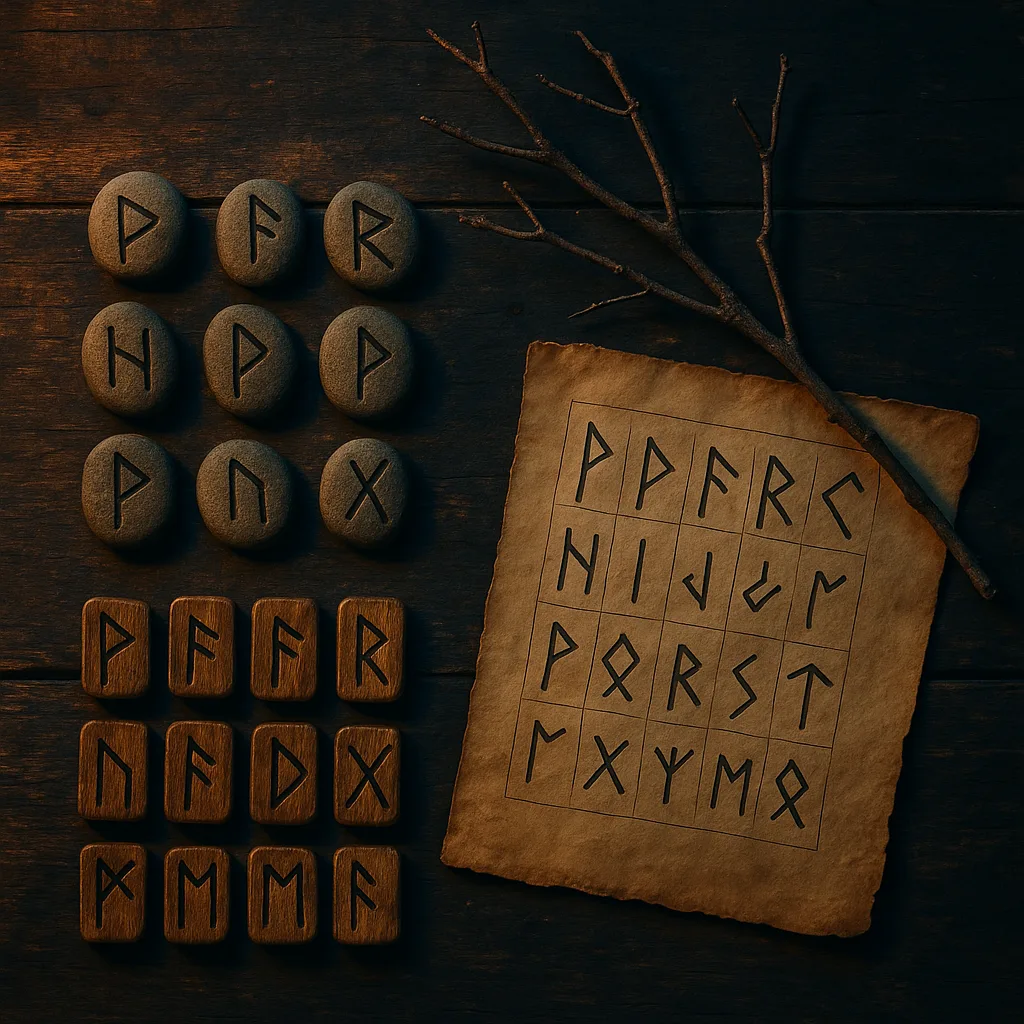
- Buying a ready-made set. Typically stone, wood or resin, already engraved with the 24 symbols of the Elder Futhark. This is the most practical option for beginners.
- Making your own set. Many practitioners prefer to carve the runes themselves onto small wooden discs or collected stones, believing this creates a stronger personal bond with the pieces.
- Using rune cards. An adapted version, closer to tarot, ideal for those who already feel comfortable with card readings and want an easier transition.
Whichever path you choose, there's an ongoing debate among practitioners about whether to include the so-called blank rune, sometimes called the Odin rune. It has no historical or archaeological basis, no ancient inscription shows a blank symbol, and it was only popularized in 20th-century divination books. Many traditionalists leave it out. Others include it to represent the unknown, or a fate not yet written. There's no wrong answer here, just a conscious choice.
Three Casting Methods to Get You Started
You don't need to throw all 24 runes at once. In fact, simple readings tend to be much clearer for beginners.
- Single daily rune. Draw one rune blindly from a bag and let it guide a reflection or answer a simple question you set before drawing. This is the best method for building a regular practice.
- Three-rune spread. Laid out side by side to represent past, present and future, or situation, challenge and advice. This is the closest structure to a three-card tarot reading, and it helps train your ability to read symbols in combination.
- Casting onto a cloth. An older, less linear method: all the runes are thrown onto a cloth marked with a circle, and only the ones that land face-up inside the circle are used in the reading. Each rune's position relative to the center also matters, which makes this method more intuitive and less structured than the others.
What If a Rune Lands Reversed?
Just like in tarot, a rune can land upside down, which usually points to a blockage, a delay, or the inverted side of that symbol's original meaning. There's an important technical caveat, though: not every rune has a distinguishable reversed position. Symmetrical symbols, like Isa or Gebo, look the same upside down, so many practitioners simply skip the reversed-meaning concept for these specific cases and apply it only to asymmetrical runes.
Before worrying about reversals, it's worth spending a few weeks just reading the runes upright. Mastering the base meaning first prevents confusion when you start interpreting variations.
Practical Habits That Make a Real Difference
A few simple habits can make your practice more consistent and more respectful of the tradition.
- Keep your runes in a cloth bag. Besides protecting the pieces, the bag is what allows for a blind draw, which is essential for methods like the daily single rune.
- Keep a record of your readings. A simple notebook with the date, your question, and the runes drawn helps you notice patterns over time, something memory alone rarely catches.
- Don't jump straight to symbolism. Before interpreting, recall the rune's literal meaning (cattle, ice, harvest). This grounds the reading and keeps you from vague generalizations.
- Avoid repeating a reading for the same question. If you don't like the result, casting again until you get a better answer defeats the purpose of the practice.
- Honor the quiet moment before turning the pieces over. A brief pause to focus on your question before casting is part of the ritual in nearly every tradition of symbolic reading.
Over time, reading runes stops being a matter of checking a list of meanings and becomes a dialogue between the question you brought to the table, the symbol that appeared, and the interpretation that only you, through practice, can weave between the two.

Recomendado
Lewtemi Espelho de tarô acrílico tarô
Lewtemi Espelho de tarô acrílico tarô cartão decoração de parede mística presentes de bruxa para mulheres espaço sagrado cartomante espiritualidade astrologia bruxa magos arte decoração

Recomendado
Zodíaco de Astrologia Kheops Pendulum Mat
Tapete de pêndulo de veludo bordado feito na Índia. O complemento perfeito para encontrar as respostas que seus clientes buscam.

Recomendado
Incensário Cascata Refluxo Cerâmica
Efeito cascata hipnotizante A fumaça desce como uma cachoeira, criando um visual relaxante perfeito para momentos de calma e foco
Universo Astral Editorial Team · Zodiac signs and fun facts
This article was produced by the Universo Astral editorial team, with AI tools assisting research and drafting and human review before publication. If you spot anything inaccurate or outdated, let us know at our contact email.