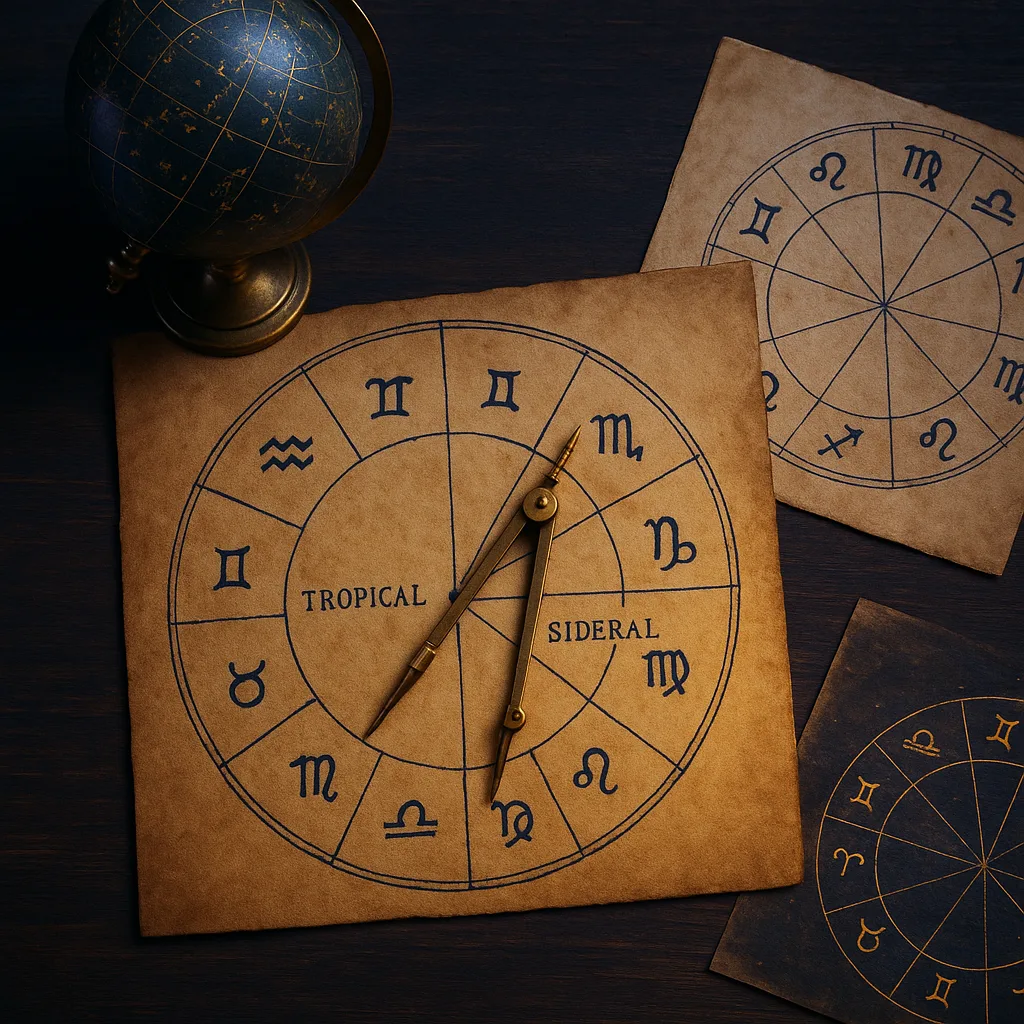
Astrology vs. Astronomy: The Real Difference Between Studying the Sky and Reading Its Signs
In 2006, the International Astronomical Union met in Prague and voted to strip Pluto of its planet status. For astronomy, this was a technical adjustment based on clear criteria for what counts as a planet. For astrology, nothing changed: Pluto still rules deep transformation, symbolic death, and rebirth in a birth chart. That single decision says a lot about how the two fields differ, and it's a good place to start.
Two ways of looking at the same sky
Astronomy and astrology observe exactly the same objects: the Sun, the Moon, the planets, the stars. The difference isn't in what's being looked at, but in what's being asked. Astronomy wants to know what a celestial body is: its chemical makeup, its mass, its orbit, its age, its physical relationship to other bodies. It does this with telescopes, spectroscopy, satellites, and equations, then puts its conclusions through tests that other scientists can repeat and check.
Astrology asks something else entirely: what that celestial body means for human experience. It starts from the position of the planets in the sky at a specific moment (someone's birth, the start of a project, today's date) and reads those positions as a symbolic mirror of life on Earth. It isn't a science in the way physics or chemistry are sciences; it's a symbolic system, a language for reading the world that carries thousands of years of cultural tradition.
When they were one and the same
This split didn't always exist. Up until roughly the 17th century, sky watchers did both jobs at once without any sense of contradiction. Civilizations such as Egypt, India, and Greece tracked the movement of the stars to guide agriculture and navigation, and also to find spiritual meaning in celestial patterns. Johannes Kepler, one of the major figures in the history of astronomy, calculated ephemerides and also cast astrological readings. Both practices coexisted in the same mind, and no one thought it strange.
The split solidified with the Scientific Revolution, when the scientific method began requiring that every claim about the universe be testable and repeatable. Astronomy followed that path and, over the course of the 18th century, became a discipline tied firmly to physics and mathematics. Astrology stayed in the territory of symbolic interpretation, never trying to prove its correspondences empirically. That difference in method, not in subject matter, is what still separates the two fields today.
The planet each field defines its own way
Pluto's case shows why this methodological line matters in practice. For astronomy, a planet has to meet specific criteria around orbit and gravitational dominance, and since Pluto shares its region of space with other bodies, it was reclassified as a dwarf planet. Astrology works from a different definition: a planet is any celestial body that moves visibly across the sky and carries its own symbolic meaning. The Sun and Moon, technically, aren't even planets from an astronomical standpoint, but astrological tradition treats them as such for convenience, even though the more accurate term for them is luminaries.
That's why reclassifications in astronomy don't affect astrological practice. It's not that astrology ignores science; the two fields answer different questions, with vocabularies that don't need to line up. An astronomer can correctly say Pluto doesn't meet the requirements to be called a planet. An astrologer, working just as consistently within a different system, keeps reading Pluto as a meaningful symbolic force in the chart.
Astronomy tells you what the planet is; astrology tells you what it means for you.
Tools and ways of validating knowledge
One useful way to spot the difference is to look at each field's tools. Astronomy relies on increasingly powerful telescopes, space probes, mathematical models, and data that any researcher with access to the same instruments can verify. Its findings feed real-world technology: satellite navigation, weather forecasting, global communication, space exploration. Its impact can be measured in tangible, everyday applications.
Astrology works with birth charts, ephemerides, houses, aspects, and transits: a vocabulary of its own, built up over centuries, that never set out to be tested by the standards of physics. Major scientific institutions, including NASA and the American Astronomical Society, classify astrology as a belief system rather than a science, precisely because its correspondences between the sky and human life can't be proven through the scientific method. That doesn't make it worthless. It simply places its value somewhere else: in self-knowledge, symbolic reflection, and the way a person makes sense of their own life through the sky on the day they were born.
Where each one makes sense today
It helps to keep the roles clearly separated so expectations don't get mixed up. Astronomy is the right place to understand physical phenomena: why the Moon changes phases, how stars are born and die, the actual distance between Earth and Saturn. If the question is about how the universe works as matter and energy, science has the answer.
Astrology, on the other hand, is the territory for those seeking meaning, not physical explanation. Reading a birth chart isn't like consulting a technical report on celestial bodies: it's using the positions of those bodies as symbolic language to think through personality, emotional cycles, and life moments. Among astrologers and regular practitioners, this distinction is usually clear and doesn't create conflict with science. They're simply different registers, similar to comparing a road map to a poem about a journey.
- Astronomy: studies the physics, chemistry, and mathematics of the universe, with testable validation.
- Astrology: symbolically interprets celestial positions as a mirror of human life, with no claim to empirical proof.
- What they share: both were born from the same human impulse to look up at the sky in search of guidance.
The more useful question isn't which field is right, but which one applies to what you're asking. Astronomy explains the cosmos as matter and energy. Astrology offers a symbolic language for thinking about a life. Both have stayed active for the same reason: people have always looked up at the sky for answers, just different kinds of answers.

Recomendado
Manual Prático da Astrologia
O universo sempre exerceu um fascínio indescritível sobre a humanidade. De todas as suas maravilhas, a astrologia se destaca como uma antiga arte que tem intrigado e inspirado gerações.

Recomendado
Astrologia, Simbolismo e Mapa das Personalidades
A astrologia acompanha a humanidade desde as primeiras grandes civilizações. A ideia de que a vida biológica na Terra pode ser influenciada pelos astros gerou e gera grande fascínio no homem.

Recomendado
Bruxaria e astrologia
Guia prático para entrar em sintonia mágica com os 12 signos do zodíaco
Universo Astral Editorial Team · Zodiac signs and fun facts
This article was produced by the Universo Astral editorial team, with AI tools assisting research and drafting and human review before publication. If you spot anything inaccurate or outdated, let us know at our contact email.