Which Zodiac Sign Rules Each Tarot Court Card?
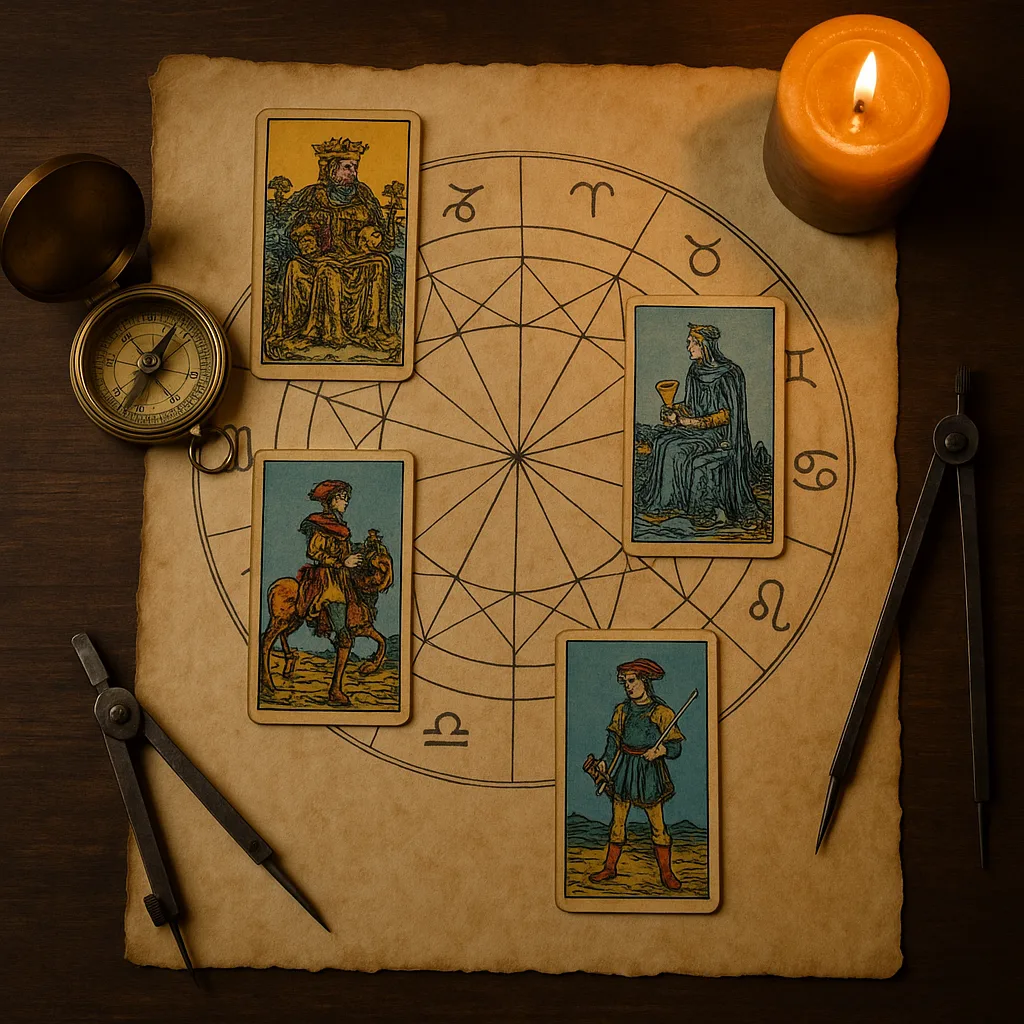
When Tarot Asked Astrology for Help
In the late 19th century, the magicians of the Hermetic Order of the Golden Dawn faced a problem: they wanted a system of correspondences that would unite all the esoteric languages of the West into a single map. Astrology, tarot, kabbalah, alchemy: everything needed to speak to one another. It was in this process that the 16 tarot court cards gained something no other group of cards in the deck has: a fixed address in the sky, calculated in decans rather than whole signs.
This means that, contrary to what many people think, a court card doesn't correspond to a full 30-degree sign, but to a 10-degree slice spanning two consecutive signs. It's a more precise, and considerably stranger, system than the simple association that usually circulates.
How the Real Decan Division Works
Each Knight in the court rules the last 20 degrees of a fire, earth, air, or water sign combined with the first 10 degrees of the following sign of the same element. He's the transition card, the movement between two territories. Queens and Kings (or Pages, depending on the tradition you consult) occupy central, more stable periods within the sign-element itself. In practice, this produces something like:
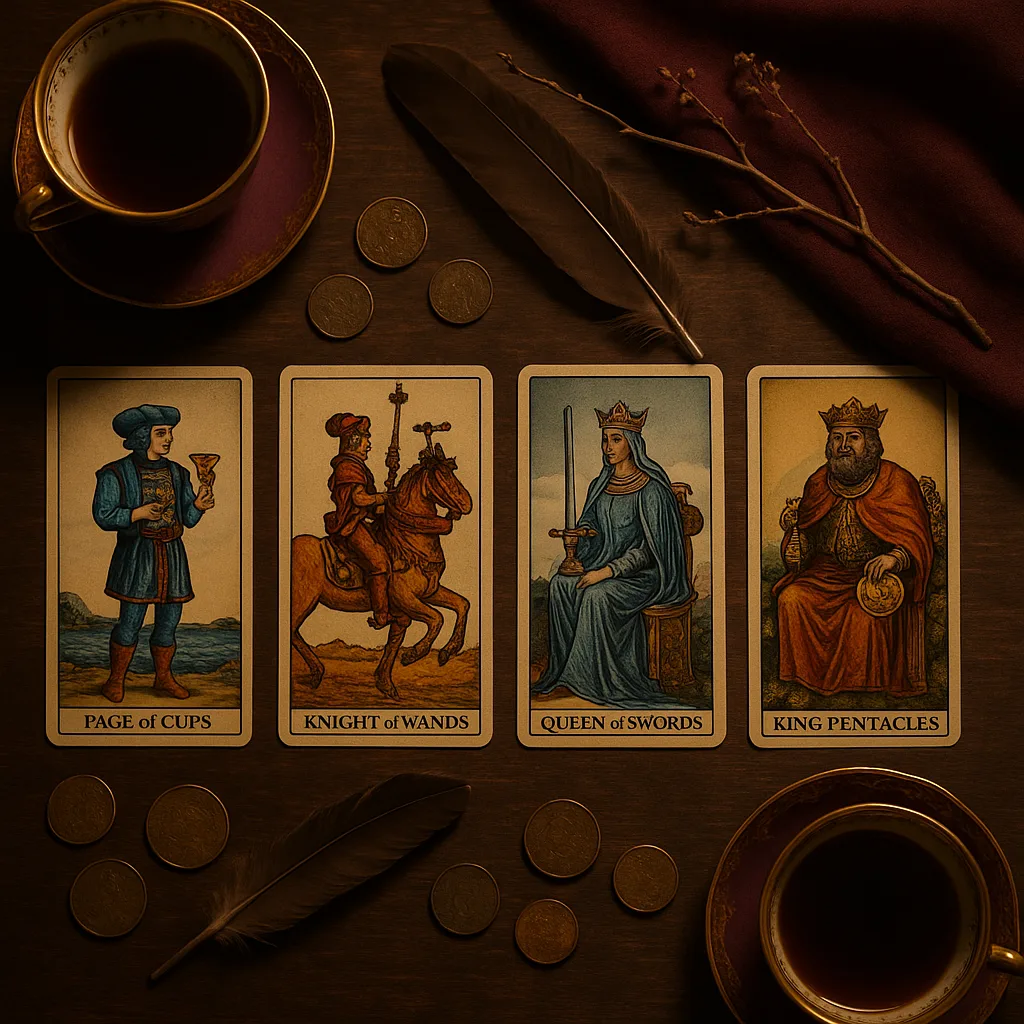
- Knight of Wands: rules from 21° Sagittarius to 20° Aries, the bridge between two fire signs.
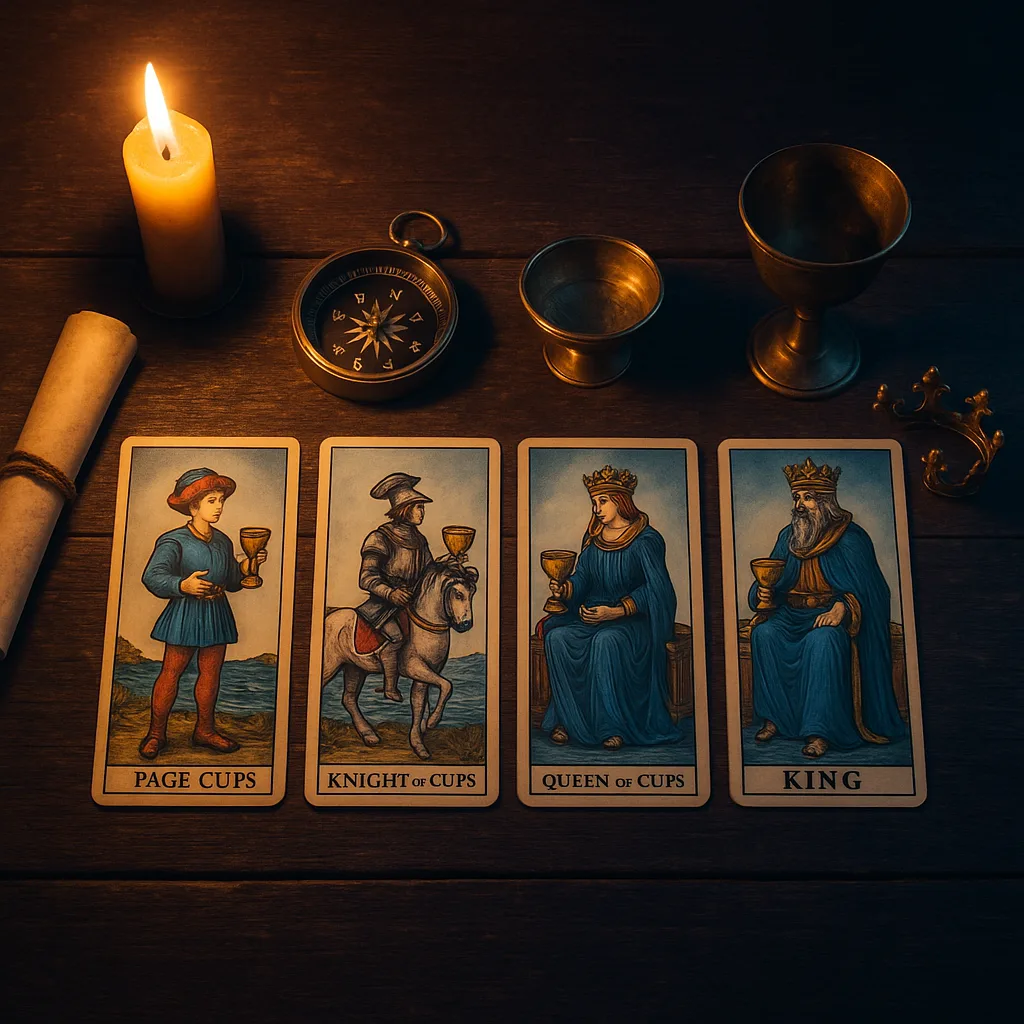
- Queen of Cups: reigns over the early part of Cancer, at the heart of the zodiac's most receptive water.
- King of Swords: takes the central stretch of Libra, when air has already taken the shape of judgment and decision.
- Page of Pentacles: has no fixed degree range like the others. He represents earth itself in a latent state, framing all three earth signs.
If this sounds complicated, that's because it is. That's exactly why most popular tarot books simplify the relationship to something like 'Knight of Wands = Sagittarius,' losing the nuance of the decans along the way.
Discover Which Card Is Really Yours
To know precisely which court card rules your specific solar degree, you'd need to consult your full birth chart. It's not enough to know 'I'm a Taurus'; you need to know at what degree of Taurus the Sun was positioned at the moment you were born. But, roughly speaking, here's the general mapping by sign:
- Aries: transitions between the Knight of Wands (early degrees) and the Queen of Wands, settled in mid-sign.
- Taurus: inhabited by the earthy, sensory energy that runs through the King of Pentacles at his peak.
- Gemini: territory of the Knight of Swords, always in motion between ideas.
- Cancer: home of the Queen of Cups, the care that anticipates another person's needs before they're spoken.
- Leo: the domain of the King of Wands, leadership that needs to be seen in order to fully exist.
- Virgo: shelter of the Knight of Pentacles, who moves slowly but never wastes a step.
- Libra: seat of the King of Swords, decision-making that seeks balance before acting.
- Scorpio: territory of the Queen of Cups in her most intense phase, followed by the Knight of Cups.
- Sagittarius: the start of the Knight of Wands' journey, fire that's born already at a gallop.
- Capricorn: home of the King of Pentacles in formation, discipline that builds structure.
- Aquarius: domain of the Queen of Swords, mental clarity that doesn't bend easily.
- Pisces: shelter of the King of Cups, emotion that has learned to hold itself and others up.
What's the Practical Use of Knowing This?
This astrological correspondence is more useful than it first appears in three concrete reading situations:
- Identifying people in a spread: if you draw the King of Cups in a question about a relationship and you know a Pisces in your life, this astrological clue can confirm (or rule out) who the card refers to.
- Choosing a significator for the traditional method: traditional readers often open a spread by picking a court card to represent the querent, based on the person's sun sign or rising sign, not physical traits like hair color.
- Understanding transit timing with tarot: practitioners who combine astrology and tarot use this mapping to know which court card is active in the sky at a given time of year, reading it as a collective energy for that period.
An important caveat: not every tarot deck follows the Golden Dawn's decan system. Many contemporary creators prefer their own attributions, or no declared astrological attribution at all. Before applying these correspondences, it's worth checking whether the deck you use follows this specific tradition.
A Second Language Behind the Figures
Looking at the court cards through the lens of decans doesn't replace the traditional symbolic reading of page, knight, queen, and king. It adds an extra layer of precision for those who already practice astrology and want to weave the two systems together. It's like discovering that a character you already knew one way also has a last name, a birth date, an exact place on the map of the sky. The figure stays the same; what changes is how much of it you're able to see.

Recomendado
Bruxaria e astrologia
Guia prático para entrar em sintonia mágica com os 12 signos do zodíaco

Recomendado
Lewtemi Espelho de tarô acrílico tarô
Lewtemi Espelho de tarô acrílico tarô cartão decoração de parede mística presentes de bruxa para mulheres espaço sagrado cartomante espiritualidade astrologia bruxa magos arte decoração

Recomendado
Manual Prático da Astrologia
O universo sempre exerceu um fascínio indescritível sobre a humanidade. De todas as suas maravilhas, a astrologia se destaca como uma antiga arte que tem intrigado e inspirado gerações.
Universo Astral Editorial Team · Tarot and moon transits
This article was produced by the Universo Astral editorial team, with AI tools assisting research and drafting and human review before publication. If you spot anything inaccurate or outdated, let us know at our contact email.