Body, Mind and Spirit: The Three-Card Tarot Spread That Reveals Your Inner Conflicts
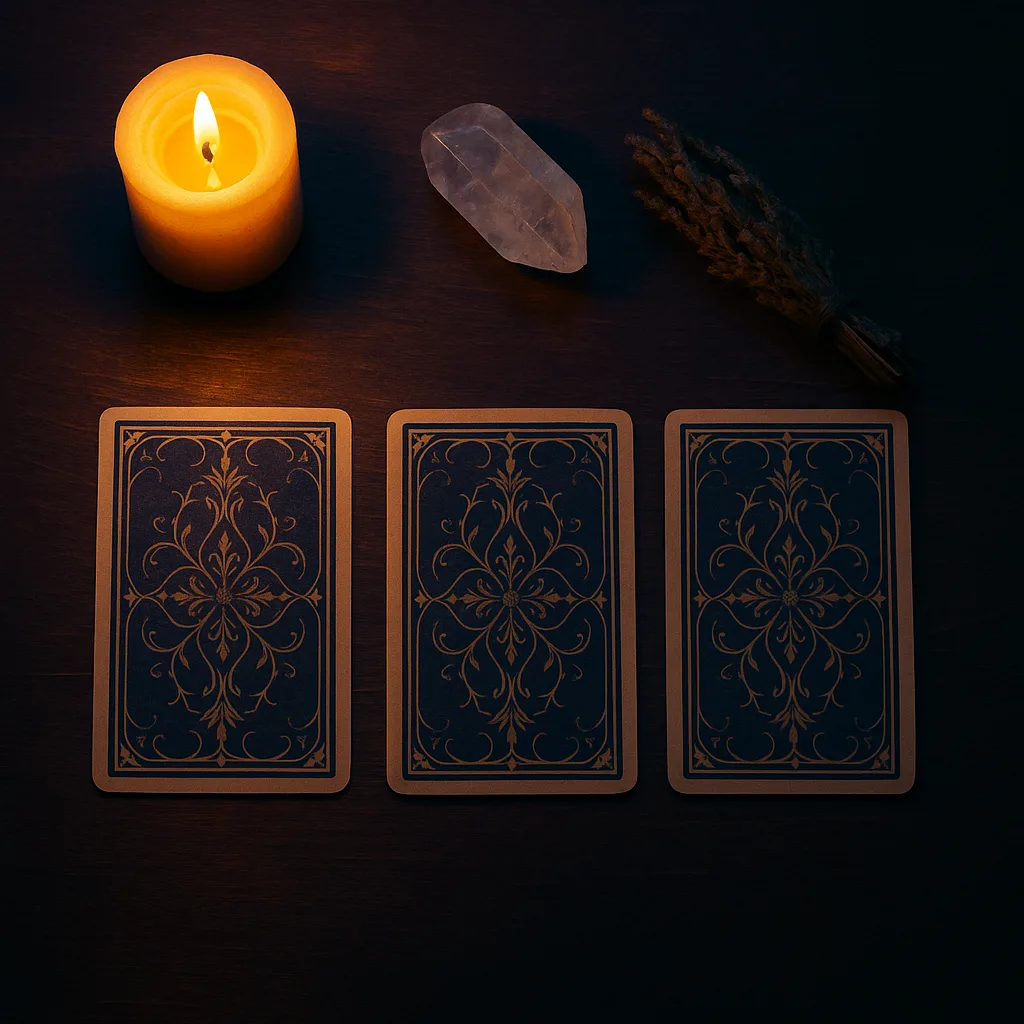
Three cards on the table, face down. No question about what will happen next week, no yes-or-no answer. This spread offers something else: a quick snapshot of how you're dealing with yourself right now. It's one of the simplest ways to use tarot, and also one of the most revealing, because it puts face to face three parts of you that almost never speak openly with each other.
Tarot as a mirror, not a prediction
There's a common expectation that tarot should work like an oracle of fate, handing out dates, names and guaranteed outcomes. Most tarot readers who focus on self-knowledge don't work that way. In this approach, the cards don't announce what will happen tomorrow: they describe what's already in motion inside you, often outside your conscious awareness.
This completely changes the point of sitting down for a reading. Instead of asking whether something will work out, the more useful question is: what is this card showing me about how I think, feel and act in this situation? A three-card spread is small enough not to intimidate beginners, yet structured enough to deliver a complete narrative, with a beginning, middle and end.
Why three cards tell a whole story
The three-card spread is almost as old as tarot itself as a tool for symbolic reading, dating back to the centuries when European occultists like Antoine Court de Gébelin and Etteilla began turning a Renaissance card game into an instrument for introspection. The number three wasn't chosen at random: it shows up in nearly every symbolic tradition as the minimum structure needed for something to feel complete. Mind, body and spirit. Birth, life and death. Past, present and future.
In practice, each of the three cards works like a point on a triangle: none carries more weight than the others, and it's precisely the dialogue between the three that creates the meaning of the reading. Pulling a single card gives you an isolated snapshot. Pulling three gives you a scene with tension, contrast and movement, which is exactly what self-knowledge calls for.
The body, mind and spirit spread
Among the possible variations, the one best suited for looking inward is the body, mind and spirit triad. It works in a particular way: body and spirit form a pair of opposing forces, and the mind steps in as the mediator between the two.
In this reading, the body represents the unconscious, the root, everything already formed and rooted in you, often without any conscious choice on your part. It's the background, the unacknowledged, the weight of the past that still lingers. The spirit is the opposite extreme: the impulse toward change, the vision of the future, the force pushing forward even when the body resists. And the mind, in the middle, is where the actual decision takes shape. It absorbs pressure from both sides and chooses, day after day, which direction to lean toward.
Reading these three cards together tends to expose a conflict you already sensed but hadn't quite named. A heavy card in the body position paired with a light card in the spirit position, for example, can describe exactly that feeling of being tired of an old pattern but still not brave enough to change it.
Other ways to arrange the three positions
The body-mind-spirit structure isn't the only option, and it's worth knowing a few others so you can adapt the reading to whatever question you're carrying that day.
- Past, present and future: shows how a situation took shape and where it seems to be heading. Good for understanding a phase, not a fixed personality trait.
- Situation, action and outcome: less introspective and more geared toward practical decisions, useful when self-knowledge needs to turn into a concrete choice.
- Strength, challenge and advice: helps name what already works for you, what's holding you back and what to do about it.
None of these variations is more correct than another. The choice depends on what you want to understand at that moment: an inner state (body, mind, spirit), a trajectory (past, present, future) or a decision (situation, action, outcome).
How to build the reading, step by step
Before shuffling anything, take your time to word the question carefully. Closed questions, the will-it-happen-or-not type, tend to produce shallow readings, because they force the card to answer something it was never meant to answer. It works far better to open up the question: what do I need to understand about this phase, what's holding me back in this relationship, what is my body trying to tell me right now.
Pick a quiet place, without rushing. Take a few deep breaths before touching the deck, just to slow down and bring your attention to the present moment. There's no single correct way to shuffle: what matters is doing it calmly, keeping the question in mind while the cards mix, and stopping when it feels right, trusting your intuition rather than counting an exact number of shuffles.
If you like an extra step, you can cut the deck into three piles and rearrange them in a different order before drawing the cards. It's not required, but it adds another layer of intention to the process.
Lay the three cards in a row, face down, from left to right. Turn them over one at a time, starting with the first position, and simply observe what appears before trying to explain everything at once. There's a strong pull to force a grand meaning onto the first card, but it's worth resisting and letting the image just sit there for a moment.
Reading the three cards as a single story
The most common mistake beginners make is interpreting each card in isolation and stopping there, as if they were three separate answers. The richest part of the reading lies in the connection between them. How does the body card speak to the spirit card? Is the mind truly mediating that conflict, or is it being pulled toward one side?
It helps to write down all three cards and, only after looking at each one individually, write a single sentence that sums up the scene as a whole, like the headline of that small story. It's usually this final summary that delivers the most direct insight: not the technical meaning of each isolated card, but the pattern they form together.
Repeating this spread periodically, always with the same broad question about body, mind and spirit, creates a kind of personal record over time. Comparing readings from different months shows whether that conflict between what weighs you down and what pushes you forward is resolving, staying stuck, or simply changing shape without you noticing.

Recomendado
Lewtemi Espelho de tarô acrílico tarô
Lewtemi Espelho de tarô acrílico tarô cartão decoração de parede mística presentes de bruxa para mulheres espaço sagrado cartomante espiritualidade astrologia bruxa magos arte decoração

Recomendado
Incensário Cascata Refluxo Cerâmica
Efeito cascata hipnotizante A fumaça desce como uma cachoeira, criando um visual relaxante perfeito para momentos de calma e foco
Universo Astral Editorial Team · Tarot and moon transits
This article was produced by the Universo Astral editorial team, with AI tools assisting research and drafting and human review before publication. If you spot anything inaccurate or outdated, let us know at our contact email.