Three Cards, Three Mirrors: How to Choose the Right Tarot Spread for Each Moment in Your Life
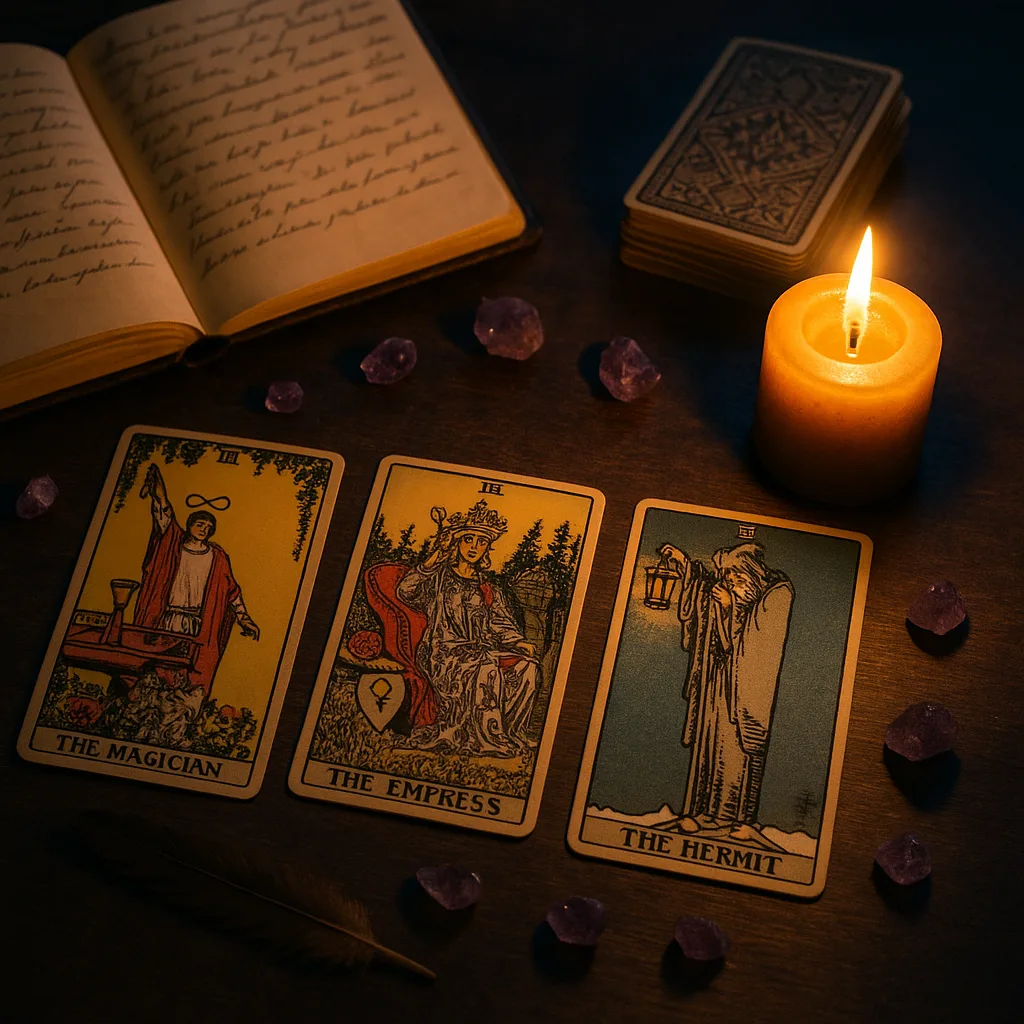
Imagine shuffling the deck without yet knowing whether the question that brought you there is about a relationship, a career decision, or simply an unease you can't quite name. The three-card spread is generous because it adapts to the question, not the other way around. Many people learn only the past-present-future model and stop there, but that's just one entry point into an exercise that can be rearranged in as many ways as you have doubts.
Tarot doesn't decide for you, it organizes what you already feel
One misunderstanding worth clearing up: pulling three cards isn't consulting an oracle that hands down verdicts about the future. It's an invitation to put into images something that's often already tangled up inside you. The cards work as a symbolic mirror, reflecting back, through archetypes, feelings and conflicts you may not yet have put into words. That's why the three-card reading is so widely used for self-knowledge. It doesn't promise certain events, it promises clarity about the present moment, about what's weighing on you, and about the paths open to the person you are right now.
This distinction changes the question you should bring to the deck. Instead of asking what's going to happen to me, it works better to ask what do I need to see about myself right now, or what's keeping me from acting. Questions turned inward, about behavior, feeling, pattern, tend to produce richer readings than questions about external events you don't control.
Beyond past-present-future: other three-position maps
The chronological layout is the best known, and it works well when you want to understand how a situation took shape: the first card shows old energies still influencing the present, the second reveals what's at stake now, and the third points to where things are headed if nothing changes. But there are three other equally powerful combinations, each serving a different kind of inner question:
- Situation, Action, Outcome: ideal when you're stuck facing a decision. The first card names the real challenge behind the indecision, the second suggests a concrete action, and the third shows the most likely outcome if you follow that path.
- Body, Mind, Spirit: a broader look at your current state. The first card speaks to what's visible, your actions, your routine, how others perceive you. The second dives into the emotional, into what you feel inside but don't always show. The third touches on something more subtle, a life lesson, a need that goes beyond the everyday.
- Strengths, Weaknesses, Opportunity: useful when you want to understand your own resources in the face of an obstacle. The first card reveals what's already working in your favor, the second exposes what needs attention, and the third points to a possible opening from there.
None of these variations requires memorizing a whole new system. The three-position structure stays the same; what changes is what each position represents. Choosing the right layout is, in practice, choosing what kind of question you're actually willing to hear the answer to.
Before you shuffle: the state of mind you bring to the table
A three-card reading done in a rush, in the middle of a phone notification, is unlikely to yield anything deep. Part of the value of this spread lies in what happens before it: choosing a quiet place, silencing your surroundings for a few minutes, and only then putting the question into words, either aloud or in writing. Some more contemplative schools of tarot argue that the first step of any reading isn't shuffling but quieting the mind, letting racing thoughts settle before asking them for a symbolic answer. You don't need to follow that ritual to the letter, but the practical lesson holds: the more scattered you are, the more superficial the reading tends to be.
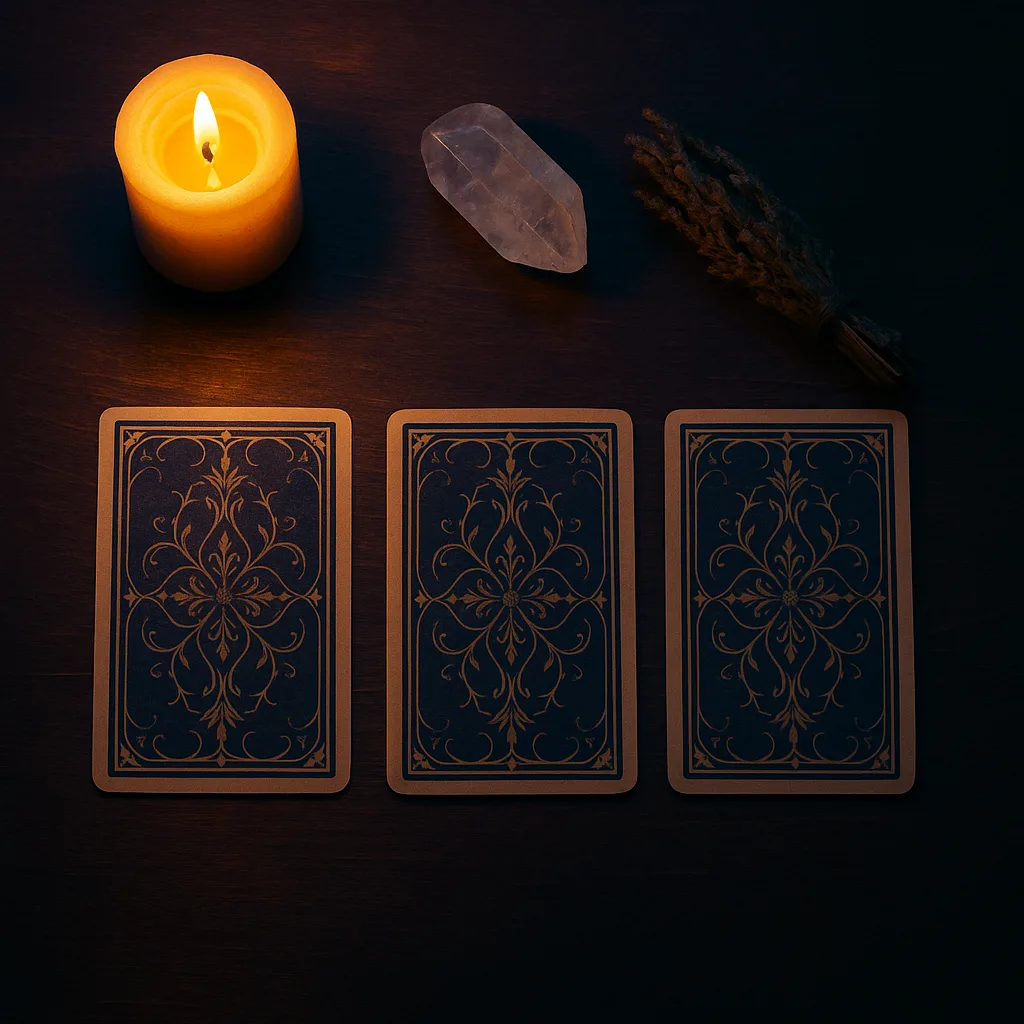
Once you've settled on your question, shuffle while holding it in mind, not mechanically. Cut the deck or fan it out, draw three cards, and lay them face down in the order of the positions you've chosen. Only then reveal them one by one, from left to right.
The answer lives in the relationship between the cards, not in each one alone
This is perhaps the most underrated point for beginners: interpreting a three-card spread isn't adding up three ready-made meanings, as if each card were an independent piece of a dictionary-style puzzle. The strength of this spread lies in the conversation that forms between the positions. A conflict card in the first position takes on a completely different meaning if the second brings a card of triumph, and yet another meaning if the second repeats the same heavy tone. Also watch for repeated suits and elements, figures that face each other or turn away in the imagery, numbers that connect. All of this is part of the story the three cards tell together.
This is where the balance between study and intuition comes in. Knowing the basic meaning of each card helps you stay grounded, but locking a reading into memorized definitions tends to stiffen the whole process. When you look at the images calmly, the colors, the gestures, the repeated symbols, intuition tends to fill in what the books don't explain, because the reading starts to directly reflect what you already feel about your own question.
When it's worth pulling the cards again
A common question is whether it's okay to repeat a spread when the answer feels too confusing or too uncomfortable to accept. As a general rule, avoid reshuffling just because you didn't like the result. That tends to turn into a search for confirmation rather than genuine self-knowledge. But it's perfectly valid to return to the deck days or weeks later, once the situation has evolved and the question is no longer exactly the same. Each new spread is a snapshot of the present moment, not a fixed truth. It's precisely because it can be redone, revisited, and compared over time that the three-card spread becomes such a valuable habit for anyone who wants to observe themselves more honestly, spread after spread.

Recomendado
Lewtemi Espelho de tarô acrílico tarô
Lewtemi Espelho de tarô acrílico tarô cartão decoração de parede mística presentes de bruxa para mulheres espaço sagrado cartomante espiritualidade astrologia bruxa magos arte decoração

Recomendado
Incensário Cascata Refluxo Cerâmica
Efeito cascata hipnotizante A fumaça desce como uma cachoeira, criando um visual relaxante perfeito para momentos de calma e foco
Universo Astral Editorial Team · Tarot and moon transits
This article was produced by the Universo Astral editorial team, with AI tools assisting research and drafting and human review before publication. If you spot anything inaccurate or outdated, let us know at our contact email.