Lunar Nodes: How Your Destiny and Life Lessons Are Written in the Birth Chart
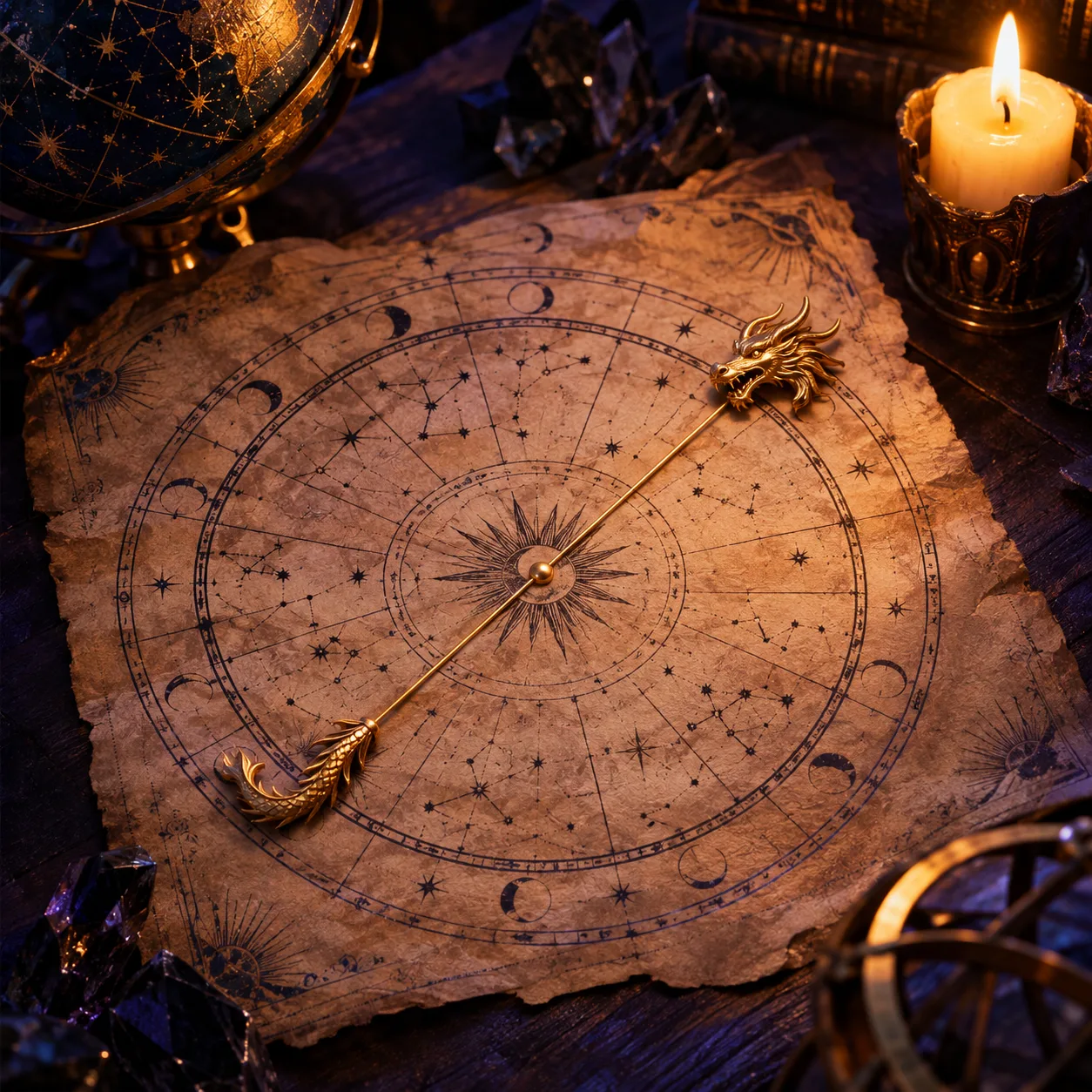
In a birth chart, two symbols resembling a dragon's head and tail almost always go unnoticed by people just starting to study their own sky: ☊ and ☋. These are the North Node and South Node, known together as the lunar nodes or nodal axis. Unlike the Sun, Moon and planets, they are not celestial bodies but mathematical points, and that changes everything about how they should be read.
What the lunar nodes actually are
The Moon does not orbit in exactly the same plane as Earth's orbit around the Sun. Its path is tilted by about five degrees relative to the ecliptic, the Sun's apparent path as seen from Earth. As a result of this tilt, there are two points where the Moon's orbit crosses that plane: one where the Moon rises into the northern celestial hemisphere (the ascending node) and another where it descends into the southern hemisphere (the descending node). This is exactly what NASA describes when explaining the geometry of eclipses, according to information published on science.nasa.gov.
These two crossing points are the North Node and South Node of astrology. They give off no light, have no mass, and do not spin: they are coordinates calculated from the intersection of two orbits. Technically, then, they cannot be called planets, though ancient traditions treated them that way, as we'll see below.
The connection to eclipses is not coincidence or loose symbolism. Solar and lunar eclipses only happen when the Sun, Moon and Earth align near one of these nodes, forming what astronomers call an eclipse season, a window of roughly 34.5 days during which this alignment becomes possible, as described on NASA's page about lunar eclipses. The symbolic layer of destiny and purpose that astrology assigns to the nodes is a cultural reading built on top of this real phenomenon, and that distinction is worth keeping clear.
North Node and South Node: two faces of the same axis
The two nodes never appear alone. They sit exactly 180 degrees apart, meaning they fall in opposite signs on the birth chart. This opposition forms what astrology calls the karmic axis, a pair that only makes sense when read together.
In Western tradition, the North Node is also called Caput Draconis (Dragon's Head) and the South Node is Cauda Draconis (Dragon's Tail). In Vedic astrology, or Jyotisha, the same points are named Rahu (North Node) and Ketu (South Node), joined with the seven classical planets to form the nine Navagrahas, a set that organizes much of Vedic interpretation.
The table below summarizes how the two points differ in function:
| Node | Other names | Time association | Symbolic function |
|---|---|---|---|
| North Node (☊) | Rahu (Vedic); Caput Draconis (Western) | Future, direction of growth | Points to unexplored territory, the lessons a person is invited to pursue in this lifetime |
| South Node (☋) | Ketu (Vedic); Cauda Draconis (Western) | Past, patterns already established | Represents baggage, innate talent and the comfort zone that can turn into stagnation if left unbalanced |
| Nodal axis (pair) | Karmic axis | , | Always in opposite signs (180°); together they form the tension and learning line most discussed in modern astrology |
A simple way to remember the difference: if the South Node is the suitcase we've carried all along, full of habits and certainties, the North Node is the destination of the trip, the place where that baggage needs to be taken, and partly left behind.
Where this reading comes from: Chaldean, Arab and Vedic roots
The image of a dragon's head and tail did not originate in Europe. It traces back to the Chaldeans, was absorbed by Zoroastrians, and later worked on by Arab astronomers and astrologers, who called the two points ra's al-jawzahar (the dragon's head) and dhanab al-jawzahar (the dragon's tail). It was the medieval Latin translation of these terms that produced caput draconis and cauda draconis, expressions that still appear in traditional astrology texts.
It's worth noting that not every medieval thinker accepted this interpretation without question. The Islamic scholar Ibn Qayyim al-Jawziyya, who lived between 1292 and 1350, asked in his work Miftah Dar al-Sa'adah why astrologers would attribute influence to al-Ra's and al-Dhanab, since they are imaginary points rather than physical bodies. It's a useful historical counterpoint: even within traditions that used the nodes, debate over their symbolic versus material nature was never absent.
The Western astrological system as we know it today began taking recognizable shape during the Hellenistic period, between 332 and 30 BCE. According to the entry on Western astrology published on worldhistory.org, ancient Greek writers credited the introduction of astrology in Greece to a Babylonian priest named Berossus, who reportedly founded a school of astronomy and astrology on the island of Kos around 280 BCE. It's within this mix of exchanges between Babylon, Greece and, later, the Arab world that the concept of lunar nodes traveled across centuries to reach the contemporary birth chart.
How to locate and interpret the nodes in your chart
Finding and reading your nodal axis doesn't require manual calculation, since any reliable birth chart software generates this position automatically. The reading process, though, follows a logical sequence worth knowing:
- Gather your exact birth date, time and location: the nodes, like the rest of the chart, depend on these three pieces of information.
- Generate your natal chart using an ephemeris or reliable software; node positions are calculated from the intersection between the Moon's orbit and the solar ecliptic.
- Locate the symbols ☊ (North Node) and ☋ (South Node); they will always sit in exactly opposite signs and houses.
- Look at the North Node's sign: it indicates the type of quality to develop over a lifetime, for example stability for someone with North Node in Taurus, or emotional depth for someone with North Node in Scorpio.
- Check which house the North Node occupies: this shows the concrete life area (work, relationships, spirituality, among others) where this growth tends to show up most strongly.
- Identify the ruling planet of the North Node's sign and look at the aspects it makes: this planet often works as a key that activates the indicated evolutionary path.
- Compare with the South Node, in the opposite sign and house, to recognize the automatic pattern, talent or comfort zone that calls for balance, not total abandonment.
- If you want to go deeper, check the approximate age of your Node Return, a milestone that occurs around ages 18-19, 37-38 and 55-57, when the nodal axis returns to its natal position and often coincides with shifts in purpose.
A few examples of axis pairs help visualize this logic in practice:
| North Node / South Node | Symbolic growth invitation |
|---|---|
| Aries / Libra | Learning to stand your ground without depending on constant validation from others |
| Taurus / Scorpio | Building stability and releasing intense, repetitive emotional patterns |
| Virgo / Pisces | Developing practical self-confidence and learning to set boundaries |
| Libra / Aries | Balancing individualistic impulse with the real value of cooperation |
| Scorpio / Taurus | Letting go of attachment to material accumulation and transforming what's stuck |
These pairs are not a fixed script but a symbolic invitation: the North Node suggests a direction for conscious effort, not an automatic obligation.
The 18.6-year cycle and recent sign changes
The nodes never sit still. They move across the zodiac in nearly constant retrograde motion, at a rate of about three arc-minutes per day. It's worth stressing that this continuous backward drift is the rule for the nodes, unlike planets such as Mercury or Venus, whose retrogrades are isolated, temporary events. Don't confuse nodal motion with the well-known Mercury retrograde periods.
This drift follows a full cycle of approximately 18.6 years, or about 6,793 days, during which the lunar pole traces a small circle in the sky around a point in the constellation Draco. Within that cycle, the nodes stay in each sign for about a year and a half before moving into the next, completing the 12 passages that make up the full circuit.
In recent, concrete terms: on January 11, 2025, the nodal axis left Aries-Libra and entered Pisces-Virgo, with the North Node moving into Pisces and the South Node into Virgo. This configuration holds until July 26, 2026, when the North Node shifts into Aquarius and the South Node into Leo, according to the ephemeris calendar described by timeanddate.com. These transitions create what some astrologers call a generational reading, since everyone born within the same roughly 18-month window shares the same nodal axis, regardless of their exact birth time.
The nodes are not the same as the Ascendant, Lilith or Chiron
It's common to mix up the lunar nodes with other sensitive chart points, but each has a distinct function. The Ascendant and Midheaven depend on the exact time and place of birth, because they mark the relationship between Earth and the horizon at that specific moment; the nodes, on the other hand, depend only on the birth date, since they result from the relative position of the Moon, Sun and Earth. Anyone who has studied the difference between sun sign and ascendant or looked closely at the first astrological house knows how much birth time matters for those two points, something that simply doesn't apply to the nodes in the same way.
It's also worth separating the nodes from Lilith (the lunar apogee) and from Chiron. Lilith speaks mainly to repressed desire and whatever culture tries to silence; Chiron deals with a specific wound and healing process. The nodal axis, by definition, is about evolutionary direction and life purpose, a broader scope less tied to a single trauma. Treating all three as interchangeable is a common mistake among people just starting to study sensitive chart points.
Frequently Asked Questions
What do the North Node and South Node mean in a birth chart?
They are mathematical points, not planets, calculated from the intersection of the Moon's orbit and the ecliptic. In astrology's symbolic reading, the North Node indicates a direction for growth and learning, while the South Node represents patterns and talents already established.
How do I find my lunar node from my birth date?
Check an ephemeris or generate your birth chart with reliable software, entering your birth date, time and location. Look for the symbols ☊ and ☋, which identify the North Node and South Node.
What's the difference between Rahu and Ketu and the Western lunar nodes?
They are the same astronomical points interpreted by different traditions. In Vedic astrology, Rahu corresponds to the North Node and Ketu to the South Node; in Western tradition, they are also called Caput Draconis and Cauda Draconis.
When does the lunar node return happen?
The return happens roughly every 18.6 years, when the nodal axis comes back to the position it held at birth. In astrology, this cycle is given symbolic interpretations tied to learning and purpose, without determining personal events.
Does the North Node reveal my life purpose?
In modern astrology, the sign and house of the North Node are often interpreted as symbols of purpose and personal growth. This reading belongs to a symbolic and cultural system; it is not proof of destiny or a deterministic prediction.

Recomendado
Mapa Astral Kármico
Você já sentiu que certos padrões se repetem em sua vida? Relacionamentos que seguem o mesmo roteiro, desafios que parecem voltar ou talentos que surgem naturalmente? Nada disso é por acaso.
Joyce Coelho Dias · Birth charts and numerology · Universo Astral Editorial Team
This article was produced by the Universo Astral editorial team, with AI tools for research and drafting, and went through automated checks of structure, links and sources before going live. If you spot anything inaccurate or outdated, let us know at our contact email.