Gibbous, Disseminating and Balsamic Moon: What the Phases Between New, Full and Waning Actually Mean
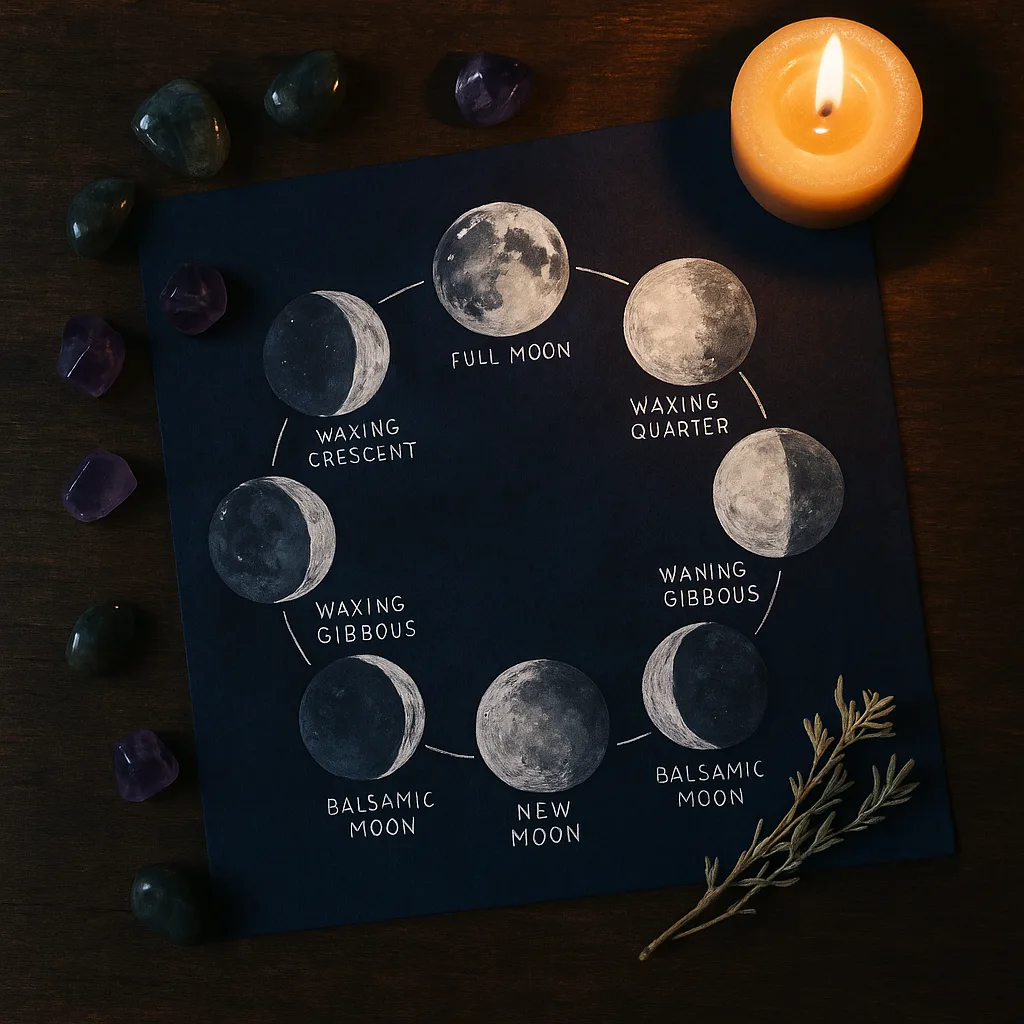
Almost every lunar calendar reduces the Moon's cycle to four drawings: a dark circle, a letter C, a full circle and a backward C. That's the simplified version most people learn, and it isn't wrong, just incomplete. Between the New Moon and the Full Moon, and between the Full Moon and the next New Moon, there are four other phases that more detailed astrology names and interprets separately: first quarter, gibbous moon, disseminating moon and balsamic moon. Together, they complete an eight-phase cycle that lasts, on average, 29.5 days, known as the synodic month.
These four in-between phases don't show up in every astrology app, but they matter for anyone who wants to follow the sky with more precision than just noting "today is the full moon." Each one occupies a specific stretch between the main phases and carries its own symbolic reading, tied to what the New Moon, First Quarter, Full Moon and Last Quarter represent as the bigger milestones of the cycle.
The cycle has eight phases, not four
Astronomically, what changes from one phase to the next is the portion of the Moon's sunlit face that we can see from Earth. The Moon doesn't produce its own light: what we see is reflected sunlight. When the illuminated side faces entirely away from Earth, we get the New Moon, and no Moon is visible in the sky. When the illuminated side lines up with the side facing us, we get the Full Moon. Between these two extremes, the amount of visible light grows or shrinks gradually, and it's in that in-between stretch that the intermediate phases live.
In the branch of astrology that works with the full cycle, these eight stages split into four main phases, called active phases (New Moon, First Quarter, Full Moon and Last Quarter), and four intermediate phases, called receptive phases: Waxing Moon, Gibbous Moon, Disseminating Moon and Balsamic Moon. Each of the eight lasts roughly three to four days, since the 29.5-day cycle splits evenly among them.
First Quarter: the turn toward action
The First Quarter marks the moment when half the lunar disc is already lit, halfway between the New Moon and the Full Moon. It's considered an active phase because it tends to coincide with decisions: whatever was symbolically planted at the New Moon starts demanding concrete movement. After it comes the Gibbous Moon, one of the least discussed intermediate phases, but with a clearly defined role in the cycle.
Gibbous Moon: fine-tuning before the full moon
The Gibbous Moon occupies the stretch between the First Quarter and the Full Moon, when the illuminated face already passes the halfway mark but hasn't reached a hundred percent yet. Symbolically, it's read as a refining phase: the project or intention already has substance, but still calls for corrections before reaching its highest point of exposure, the Full Moon. It's a time associated with reviewing details, testing what's been built, and adjusting course, rather than simply waiting for the result to show up on its own.
After the Full Moon, when the light starts to shrink, the first of the intermediate phases on the waning side begins: the Disseminating Moon.
Disseminating Moon: sharing what the full moon revealed
The Disseminating Moon comes right after the Full Moon, at a point when the illuminated face is still large but has already begun to shrink. In its symbolic reading, this phase lives up to its name: it's time to disseminate, to share what became clear during the full phase. If the Full Moon is the point of revelation and maximum clarity, the Disseminating Moon is the moment to turn that clarity into something useful for others, whether that's information, a lesson learned, or an achievement worth sharing.
After it, the light keeps shrinking until it reaches the Last Quarter, the second active phase on the waning side of the cycle, traditionally associated with letting go of what no longer serves and tying up loose ends. Only after the Last Quarter does the cycle enter its quietest phase of all: the Balsamic Moon.
Balsamic Moon and the so-called Dark Moon: the deep closing
The Balsamic Moon is the last of the eight phases, the final stretch before the Moon disappears completely and starts over as the New Moon. During it, the illuminated face is just a thin sliver, almost gone from the sky. More esoteric astrological traditions often call the final three days of this phase the Dark Moon, understood as the deepest closing point of the entire cycle: less about starting something new and more about emptying out, resting, and letting go of what has already served its purpose before the New Moon starts everything over again.
This reading helps explain why the New Moon is usually described as a beginning and the Balsamic as an ending: one is a direct consequence of the other. A fresh start only makes sense once the emptying out of the Balsamic phase has actually happened, which is why many astrological traditions recommend treating the last days before the New Moon with more stillness than urgency to act.
Why it's worth tracking these phases too
Anyone who only looks at the four main phases tends to mark the month in four broad blocks: plant, act, reveal, release. That works, but it simplifies a cycle that in practice has more nuance. The Gibbous Moon signals there's still time to make adjustments before the exposure of the Full Moon. The Disseminating Moon suggests that what's been revealed holds more value when shared than when kept to yourself. And the Balsamic Moon is a reminder that every fresh start, including the one at the next New Moon, depends on an emptying that came before it. You can't jump straight from exhaustion to a new beginning without passing through that gap.
There's also a parallel with the behavior of the tides themselves: the strongest tides, called spring tides, happen exactly at the New Moon and the Full Moon, when the Sun, Earth and Moon line up. During the quarters, first and last, tidal strength drops considerably, something astronomers call a neap tide. It's a fitting physical metaphor for what astrology describes symbolically: the main points of the cycle concentrate more intensity, while the intermediate phases call for quieter, more behind-the-scenes adjustments.
Paying attention to these four lesser-discussed phases doesn't replace watching the new, waxing, full and waning moons, but it fills out the picture. It's the difference between following the sky through four separate snapshots or watching the whole film, transitions and all, that link one scene to the next.
Recomendado
Astro Reflexo
Descubra o que os astros revelam sobre quem você é. Em menos de um minuto, calculamos seu Sol, Lua e Ascendente com precisão astronômica e uma inteligência artificial escreve um resumo personalizado só para você.

Recomendado
Manual Prático da Astrologia
O universo sempre exerceu um fascínio indescritível sobre a humanidade. De todas as suas maravilhas, a astrologia se destaca como uma antiga arte que tem intrigado e inspirado gerações.

Recomendado
Astrologia, Simbolismo e Mapa das Personalidades
A astrologia acompanha a humanidade desde as primeiras grandes civilizações. A ideia de que a vida biológica na Terra pode ser influenciada pelos astros gerou e gera grande fascínio no homem.
Universo Astral Editorial Team · Tarot and moon transits
This article was produced by the Universo Astral editorial team, with AI tools assisting research and drafting and human review before publication. If you spot anything inaccurate or outdated, let us know at our contact email.