The Hidden Secrets in Astrology's Glyphs: Why the Symbols Look the Way They Do
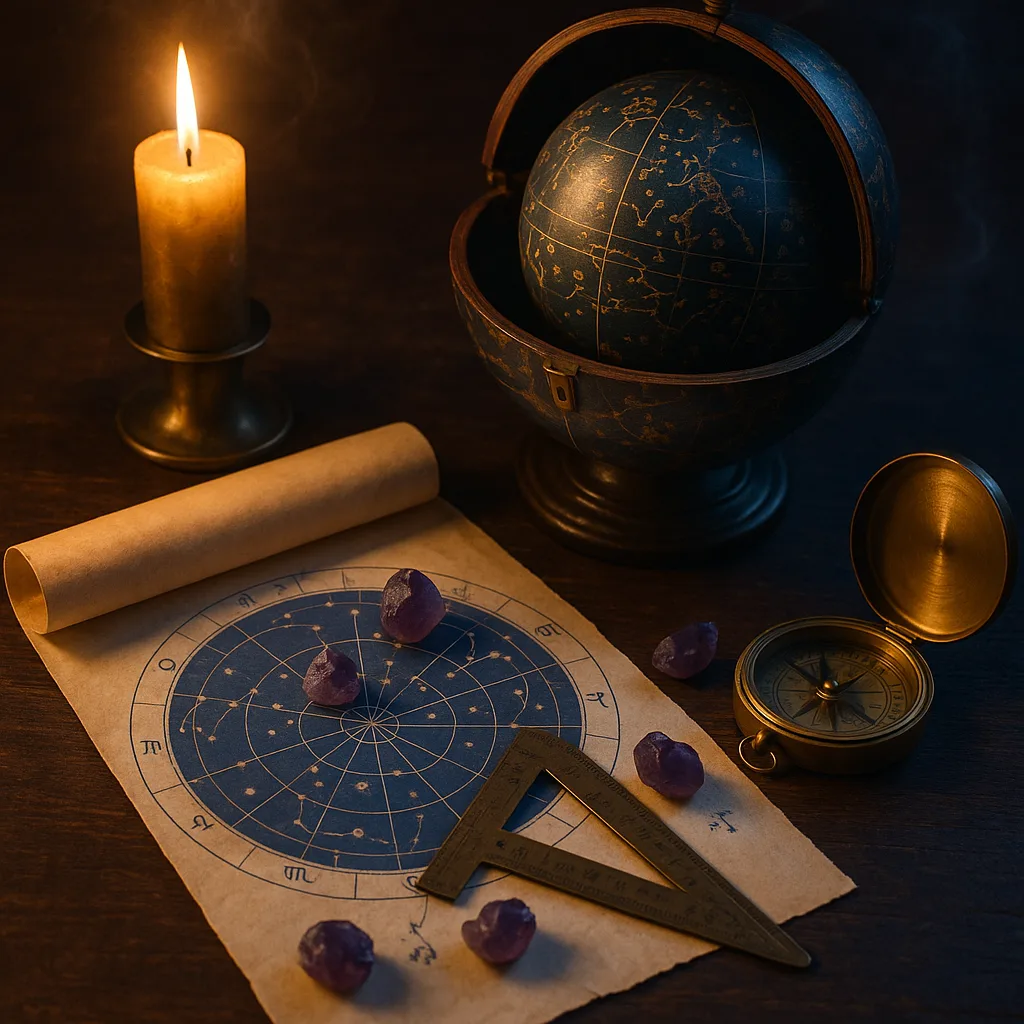
On October 28 in the year 497, a Byzantine astrologer drew up a horoscope using symbols nearly identical to the ones any astrologer might scribble on a napkin today. The document survived, was catalogued by historians of Greek astrology, and proves something curious: the glyphs we use to represent planets and signs aren't a recent invention or the aesthetic whim of some birth chart website. They're a visual code with over fifteen hundred years of continuous use — and in some cases, much more.
An alphabet with just three letters
Look closely and you'll notice that almost every astrological glyph — the twelve signs and the ten planets used in modern astrology — is born from a combination of three simple shapes: the circle, the cross, and the semicircle (or crescent). It's as if the sky had its own alphabet, one with only three letters that rearrange themselves to spell out every word.
In a symbolic reading rooted in alchemical tradition, each shape carries its own meaning: the circle represents spirit, that which has neither beginning nor end; the cross represents matter, the concrete world where things take shape; and the semicircle represents receptivity — like an antenna open to catch something greater. When you look at Mercury's glyph, for instance, you're seeing all three shapes stacked in sequence: first receptivity, then spirit, then matter. It's not random — it's a synthesis.
Two origins, two different points in history
A rarely mentioned detail is that the planetary glyphs and the zodiac sign glyphs weren't born together, or even in the same place. The planetary symbols trace back to the ancient merging of astrology and alchemy, back when both practices still walked hand in hand with what would eventually become astronomy and chemistry. More recent research places the first links between celestial bodies and mythological figures in ancient Mesopotamia, around the 5th century BCE, when the Babylonians had already divided the ecliptic into twelve equal parts and connected each visible planet to a deity — Mars to the war god Nergal, Venus to the fertility goddess Ishtar.
The zodiac glyphs, on the other hand, have a later and much better-documented history. According to historians of astrology, they first appear in Greek papyri from the late Hellenistic period, were preserved and copied by Byzantine scribes throughout the Middle Ages, and only took on the stylized form we recognize today during the Renaissance. In other words: when you sketch the symbol for Cancer or Sagittarius, you're repeating a mark that passed through at least three distinct historical eras before reaching you.
The winged helmet hidden in Mercury's glyph
Few symbols are as literal as Mercury's. Look at the glyph — a semicircle sitting atop a circle, crossed by a vertical line — and you're looking at a miniature portrait of the Roman god Hermes-Mercury: the semicircle on top is the wings of his winged helmet, the circle below stands for the god's skull (or face), and the cross at the base suggests his body or the staff he carried as messenger of the gods. It's a glyph that functions almost like an ancient emoji: a condensed image telling a full mythological story in just a few strokes.
From Venus and Mars to restroom signs
If there's one fact capable of surprising even people who've never cared about astrology, it's this: the symbols ♀ and ♂, used since antiquity to represent the planets Venus and Mars, are the exact same symbols now found on restroom doors, forms, and biology textbooks to indicate female and male. The bridge between these two uses has a name, a date, and a reason — and none of it is mystical.
The person responsible was Swedish naturalist Carl Linnaeus, the same man who created the species classification system still used today. In 1751, in his work Plantae Hybridae, he needed a quick way to indicate which plant was the 'mother' and which was the 'father' in a hybrid cross. Rather than write out full words, he borrowed the astrological glyphs: Venus for the female parent, Mars for the male. According to records from the time, the reasoning was purely practical — saving space in his lab notes. From there, the symbols migrated from astrology into biology and, decades later, into visual culture worldwide.
There's also a curious footnote about the technical limits that shaped this history: in 1845, an American doctor devised an alternative notation — triangles and squares for men, circles for women — simply because the printing press he used didn't have movable type for Venus and Mars in its set. Sometimes the history of symbols is made as much of typography as it is of mythology.

Recomendado
Manual Prático da Astrologia
O universo sempre exerceu um fascínio indescritível sobre a humanidade. De todas as suas maravilhas, a astrologia se destaca como uma antiga arte que tem intrigado e inspirado gerações.

Recomendado
Astrologia, Simbolismo e Mapa das Personalidades
A astrologia acompanha a humanidade desde as primeiras grandes civilizações. A ideia de que a vida biológica na Terra pode ser influenciada pelos astros gerou e gera grande fascínio no homem.