Choleric, Sanguine, Phlegmatic, Melancholic: The Four Temperaments Hidden in the Astrological Elements
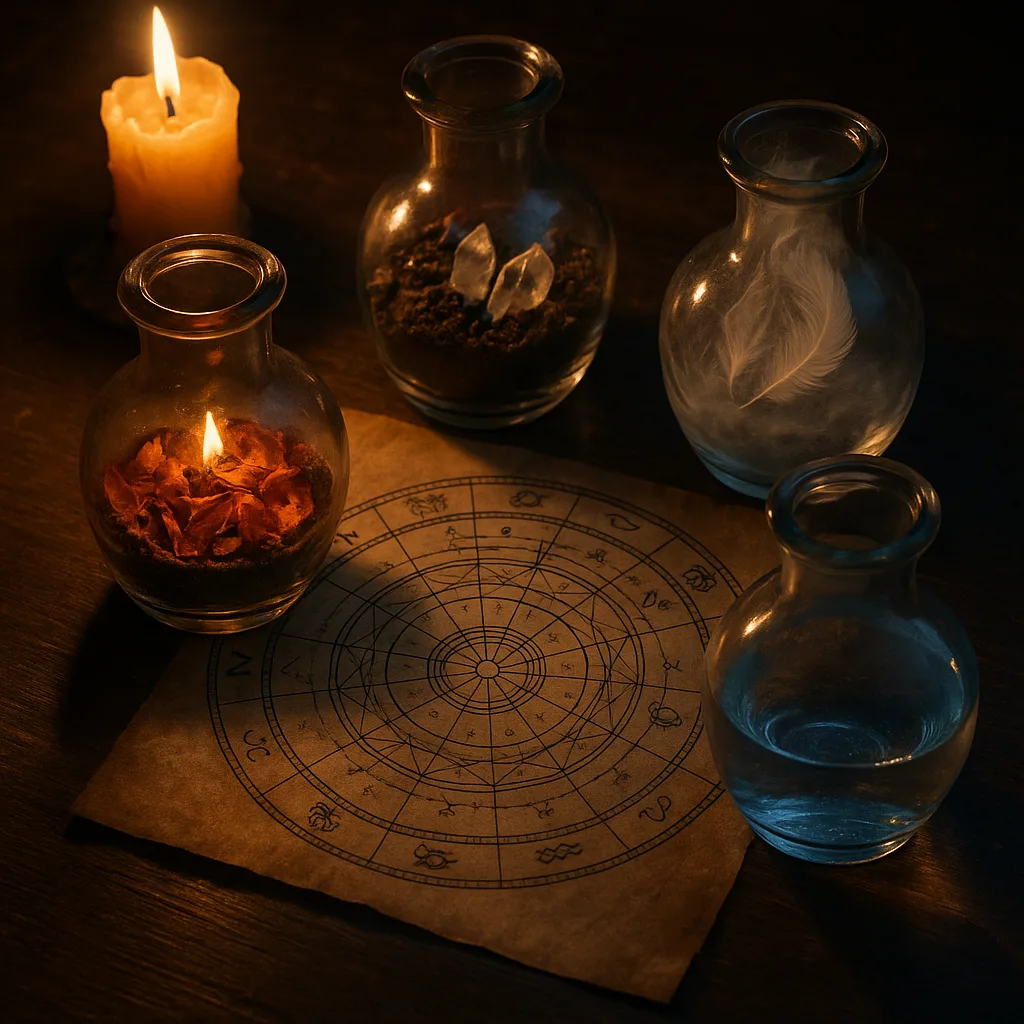
In the 5th century BCE, a physician named Hippocrates was trying to explain why people got sick and why they reacted so differently to the same situations. The answer he proposed didn't come from anatomy, but from an idea already circulating among philosophers: that everything in existence is made of four primordial substances. That's how fire, earth, air and water, originally conceived as the raw matter of the universe, found their way into the human body and, centuries later, into astrology.
From cosmic matter to human temperament
The idea of four elements as the basis of everything had already been sketched out by several Greek thinkers before Hippocrates: Thales bet on water as the origin of all things, Anaximenes argued for air, Xenophanes included earth, and Heraclitus insisted on fire. It was Empedocles of Agrigento, in the 5th century BCE, who wove these four separate ideas into a single theory, arguing that fire, earth, air and water have coexisted since the beginning of time, in proportions that vary in every existing thing.
Hippocrates took this philosophical foundation and applied it to medicine: if the cosmos is made of these four elements, the body should reflect that same composition. Later, in the 2nd century CE, the physician Galen formalized this idea into four bodily fluids, the humors, each linked to an element and a season of the year. Out of that combination came the four temperaments that, centuries later, would echo in the way astrology describes each zodiac triplicity.
Choleric: the temperament of fire and summer
The choleric temperament was linked to fire and to summer, the hottest stretch of the year. In the classical description, the choleric person is energetic, decisive, driven by a strong will to act and little patience for waiting. It's easy to see the parallel with Aries, Leo and Sagittarius, the zodiac's three fire signs: signs that need to express themselves, lead and conquer, moved by an almost physical urge to turn intention into immediate action. In that ancient framework, summer's heat isn't just a season. It's the image of a body (and a personality) that burns from within and needs to spend that energy out in the world.
Melancholic: the temperament of earth and autumn
Earth was given the melancholic temperament, tied to autumn, the season when nature slows down and things turn inward. The classic melancholic is described as reflective, cautious, inclined to weigh every decision before acting. That description lines up directly with Taurus, Virgo and Capricorn: signs that build slowly, respect concrete limits and prefer the security of a well-grounded goal to a leap in the dark. It's no accident that the expression 'keeping your feet on the ground' comes from this exact same logic of an element that resists haste and values what can be touched, measured, and earned step by step.
Phlegmatic: the temperament of water and winter
The water element received the phlegmatic temperament, associated with winter, a season of withdrawal and slower rhythms. In ancient medical tradition, the phlegmatic person was seen as calm and quiet, but also prone to deep internal swings, sensitive to stimuli that don't always show on the surface. Cancer, Scorpio and Pisces carry that same pattern in astrological terms: they're the signs tied to emotion, to bonding, to a sensitivity that can be quiet on the outside and intense on the inside. The idea that water people can recognize each other from a distance, without exchanging a word, has its roots in this same logic of an element that works less through visible action and more through emotional resonance.
Sanguine: the temperament of air and spring
Finally, air was linked to the sanguine temperament and to spring, the season of blossoming and movement. The classic sanguine type was described as sociable, curious, optimistic, always looking for novelty and connection with other people. That's the same portrait astrology paints of Gemini, Libra and Aquarius: signs organized around exchange, conversation and the circulation of ideas. In this framework, air is never a still element. It moves between one point and another, carries information, connects what was separate, much like spring scatters seeds and fresh starts across the landscape.
Why this medical legacy still matters
This bridge between elements, humors and seasons didn't stay confined to antiquity. For centuries, particularly through medieval Arab science, the theory of the four elements kept astrology intertwined with medicine, at a time when diagnosing an illness and reading a birth chart were closely related practices, often carried out by the same person. That fusion only began to break apart with the arrival of the Age of Reason, when medicine and astrology went their separate ways.
In the 20th century, psychiatrist Carl Jung revived part of this ancient logic, but shifted the focus from the body to the mind. He recognized in the zodiac's fire, earth, air and water triplicities the oldest known psychological typology, and saw in them the seeds of the four functions he would later describe in his own theory: fire as intuition, earth as sensation, air as thinking, and water as feeling. Interestingly, Empedocles had already noted, back in ancient Greece, that people with the four elements more evenly balanced tended to have a broader, less distorted perception of reality. Centuries later, Jung reached a similar observation with his patients, looking not at bodily humors anymore, but at the balance (or imbalance) of psychic functions.
Knowing that choleric, sanguine, phlegmatic and melancholic came long before any birth chart doesn't change what fire, earth, air and water mean in astrology today, but it explains why these four categories feel so natural and so ancient at the same time. They passed through Greek medicine, natural philosophy, Arab science and modern psychology before arriving at the zodiac wheel as we know it, each triplicity carrying a piece of this long conversation between body, temperament and cosmos.

Recomendado
Manual Prático da Astrologia
O universo sempre exerceu um fascínio indescritível sobre a humanidade. De todas as suas maravilhas, a astrologia se destaca como uma antiga arte que tem intrigado e inspirado gerações.

Recomendado
Astrologia, Simbolismo e Mapa das Personalidades
A astrologia acompanha a humanidade desde as primeiras grandes civilizações. A ideia de que a vida biológica na Terra pode ser influenciada pelos astros gerou e gera grande fascínio no homem.

Recomendado
MAPA ASTRAL E NUMEROLÓGICO PERSONALIZADO
Mapa Astral + Numerologia Um mergulho profundo na sua essência. E se tudo o que você procura… já estivesse dentro de você - esperando para ser revelado?
Universo Astral Editorial Team · Zodiac signs and fun facts
This article was produced by the Universo Astral editorial team, with AI tools assisting research and drafting and human review before publication. If you spot anything inaccurate or outdated, let us know at our contact email.